Happenstance with James Bond and Hemingway
On the trail of 007 in South Florida
Part 3: Key West and the Shadow of Hemingway
By Ian Dunross
March 6, 2026
- The lost bar of Bimini
- Prospero's credo in a luxury hotel
- Brief encounter in Sloppy Joe's Bar
- To have and have another
- Rambling thoughts in an existentialist pub
- For whom the boredom tolls
- Landmarks of Licence To Kill
- A whisper of sorrow, a whisper of solitude
- From Hemingway to 007
- The carnival of impermanence
- Notes
- List of Illustrations
- Works Cited

When I saw it on the recci . . . The idea of a causeway going 150 miles straight out into the Caribbean like that. It looked so beautiful from the air. It made me think, "Wow!". In Europe people aren't quite so used to that sort of thing. But it struck me as something quite unusual.
― John Glen, "Chatting at the Plaza"
![[Seven Mile Bridge]](images-keywest/bridge1.png "[Seven Mile Bridge]")
12/27/15, 8:30 a.m. EST ― I remembered director John Glen's comment as I saw the bridge, through the car windshield, glistening in the morning sunlight. Shaped almost like a giant sine wave, it towered over vast turquoise waters, signaling the famous Seven Mile Bridge—part of a series of giant arches of concrete and steel that highlight a portion of the Overseas Highway, an engineering feat in itself that spans through the Florida Keys as the southernmost segment of U.S. Route 1.
We've been on this passage for the last two hours. Aside from a brief stop at Islamorada, where we checked into our hotel, it had been a steady drive southwards, having just passed through Marathon Key, as we headed toward Key West. I'd have to agree with the travelogue claptrap: the route is breathtaking, a vibrant seascape of shimmering waters and backdrops of swaying palms, forcing you to marvel that you're gliding over coral and limestone islets. The route's history is also remarkable, based on a trail envisioned in 1912 by Henry Flagler when he extended his Florida East Coast Railroad from Miami to Key West. From time to time, I peered at the sky, ignoring the left-over Christmas music blaring from the car speakers, hoping to find a coast guard helicopter looming in the area, just as in the pre-titles of Licence To Kill.
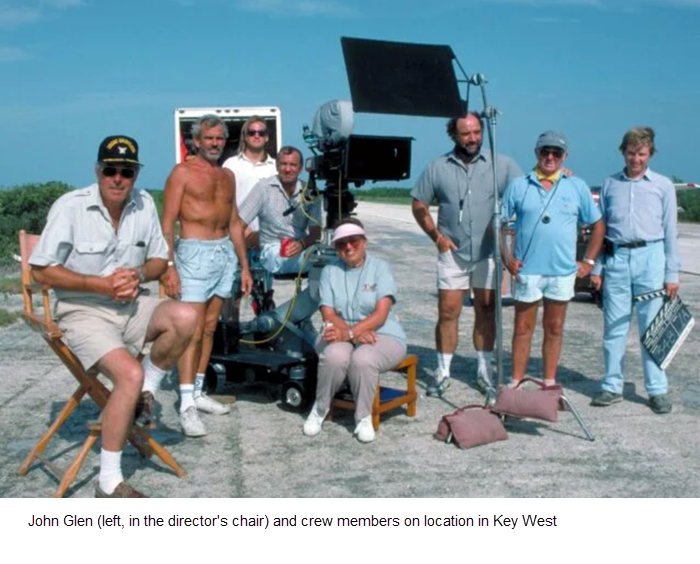
John Glen filmed the Key West sequence in August 1988. He and producers Cubby Broccoli and Michael G. Wilson decided on a Caribbean setting when the logistics to shoot in China turned out to be difficult and costly. By January 1988, they considered several islands but selected Key West because "it was not as expensive as most Caribbean locations, yet it is exotic with the right atmosphere for a smuggling story" (Hibbin 12). The bulk of the filming took place at the western end of the island―the area that I convinced the Anonymous Gang, in yet another nefarious scheme, to visit.
The lost bar of Bimini
We reached Key West by 9:40 a.m. I announced to the group that our first stop was the Garrison Bight Marina, pointing out excitedly (and ignoring their puzzled expressions) that it served as the location for the Barrelhead Bar in Licence To Kill.
"In the movie, the bar is in Bimini but they filmed the scene here," I explained as our SUV settled in the parking lot.
"Make it quick," said our designated driver, as I stepped out of the vehicle. My niece, Kristen, followed me. It was too early in the morning and, not surprisingly, the bar was closed. Then again, it was an apt situation considering I was with a minor. I stared at the facade of the building as I clutched the Leica camera. There, in the morning sunlight, was the sign for the Barrelhead Bar, scuffed and faded, and still eroding in the sea breeze. As it is, there was hardly any recognition that the Bond empire had filmed here. The bar occupied the ground floor of the Thai Island Restaurant, which had a balcony overlooking the marina. From behind, I heard my niece's voice, pulling me out of my reverie.
"So what's so great about this place? It's like a boat yard."
"It's where the hero gets into a fight in this bar. It's also the scene where he meets one of the villains."
"Oh, the Gold Hand guy!"
I chuckled.1 "It's another villain, a guy called Dario.” We walked to the front of the bar, and I peered through the window to re-stage the fight scene in my mind's eye. I smiled, noting the magic of filmmaking. In the movie, the interiors (designed by Peter Lamont) were filmed in Churubusco studios in Mexico City.
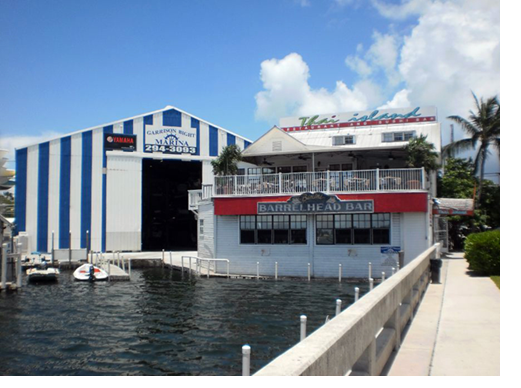
Adjacent to the bar was the marina storage. An employee greeted us, hollering a friendly "good morning" from the distance.
"Can I help you?" he asked as he walked to us. Here was a brief chance to talk to a local about Licence To Kill.
Sad to say, he knew nothing of the film. "But the restaurant opens at 10," he said and proudly pointed out that the Garrison Bight facility was the only dry storage marina in Key West and that it also had a full-service for repairs and charters.
At the parking lot, the designated driver started pounding the car horn. The marina employee kindly offered some directions to Mallory Square and Duval Street (the heart of Key West). It was the end of my excursion into that night scene in Licence To Kill wherein, on this very dock I was walking along, Bond arrives by motorboat to a replication of Bimini and gets into a barroom brawl in a studio interior in Mexico City.
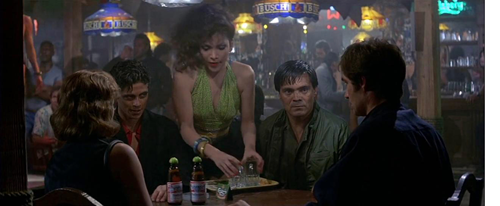
The scene harks back to the grim, seedy, noirish atmosphere in Fleming's Live and Let Die. Hats off to the filmmakers for bringing this element into their script, along with other bits from that novel, primarily the scenes in St. Petersburg, Florida, which they adapted for the Felix Leiter/shark mauling torture, the fight in the fish warehouse (aquariums are shattered by bullets in the film, just as in the novel), and the treacherous Kilifer falling through a trap door over a shark tank (reminiscent of the fate of The Robber, a minor henchman in the novel). Fleming was clearly inspired by the Florida/Caribbean literary tradition of pirate yarns and smuggling adventures but, in the advent of his day, he wrapped it all in the edgy noir detective genre by the likes of Dashiell Hammet and Raymond Chandler. Key West itself has its own literary tradition, an offshoot, one could say, of the Caribbean literary genre. It suggests the appeal of the region as a dramatic setting, gaining its most prominent treatment in James Fenimore Cooper's jack Tier, Or The Florida ReeF (1848). Even many of the tropes in Key West fiction—espionage, smuggling, seafaring—as noted in Key west Hemingway: A Reassessment, was already established by the time Hemingway arrived in 1928 (11) and certainly prominent by the time Ian Fleming sat down in Goldeneye to write Live and Let Die in 1953. Yet in Licence To Kill, aside from the dark atmosphere of the genre and the aforementioned scenes adapted from the novel, not much else was taken from Fleming. The filmmakers completely discarded the homages to Caribbean mythology and the pessimistic, even fatalistic themes, that Fleming explored in this, his second novel.2
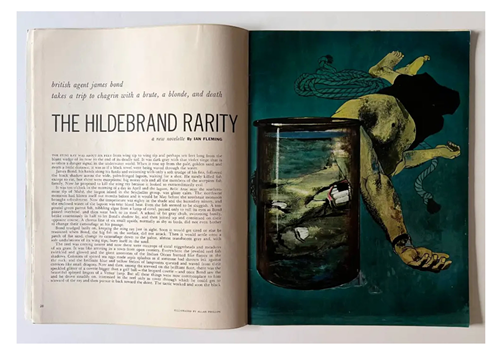
Instead, director Glen and his cohorts pulled elements from Fleming’s short story “The Hildebrand Rarity”—specifically, the Milton Krest character and his yacht Wavekrest, with a faint allusion to the “Corrector,” a whip made from the tail of a stingray that the sadist Krest uses to tame his wife, although in the film it resembles thick rope that the main villain, Franz Sanchez, uses on his straying mistress. These bits of Fleming material are sporadic in the film and completely out of context from the short story.3
Prospero's credo in a luxury hotel
Back in the SUV, I asked the gang to drop me off at the La Concha Hotel on Duval Street. I had explained earlier that the hotel had an association with the sixteenth Bond film but it was coolly received by my fellow travelers. Hence, the agreement was to regroup at the entrance of the Hemingway house at 11:30 a.m. The gang would visit the Key West Aquarium and Mallory Square, the perfect distraction for them, while I walked to essential spots associated with Timothy Dalton's second and final Bond film. The La Concha Hotel was a convenient location: Mallory Square was about half a mile away; the aquarium and Sloppy Joe's (the famous bar) were within easy walking distance; and Hemingway's pad was a decent one-mile walk, giving me a chance to be alone on my Bondian pilgrimage.

The La Concha Hotel opened in 1926, the first of its kind on the island. Inside, as I gawked at the marble floors and the luxurious decor, the concierge wondered if I was a guest. He knew bits of the history and eagerly recited names of the famous who have stayed at this landmark hotel. The likes of Tennessee Williams, Harry Truman, and Hemingway himself (presumably, before his house was built) had been guests. Yet I wasn't surprised that the concierge, who in my out-of-control imagination resembled the hotel manager in Licence To Kill, knew nothing about the film. For the record, he also did not say, "You'll be pleased to know your uncle has arrived. I put him in your suite," just as the character explains to Dalton's Bond in the hotel-casino on Isthmus Island. Instead, the concierge politely encouraged me to leave the premise because I was not a guest. Not one to stir controversy—after all, there might have been some of Sanchez's burly henchmen in the boiler room, waiting to attack—I thanked the chap and looked at the lobby one last time: it was here (as mentioned by an acquaintance in Fort Lauderdale4) where the general cast and crew had stayed and that the hotel also served as the production office. Thus began a theme that haunted me as I roamed Key West: there was a time when the Bondian world had mattered to this locale, received warm reception in a lingering moment, though it quickly vanished, melted into thin air (to borrow Prospero's words), into nothing more than, alas, "the baseless fabric of this vision" (The Tempest, lines 150-151).
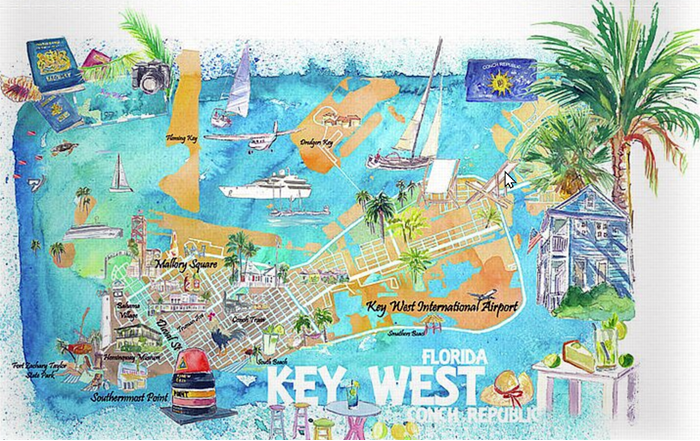
Outside, there was a cool tropical breeze and I imagined it was the so-called Doctor's Wind bringing the sweet air in from the sea, as described in Live and Let Die (163). Right in front of me was Duval Street, renowned as the heartbeat of Key West, running north and south, about a mile or so in length, bustling with shops, restaurants, and pubs. Next on my agenda, however, was The Marquesa, the hotel where Timothy Dalton supposedly stayed. It was a brisk walk, about two blocks away on a street aptly named Fleming Street. Renovated from 1884 conch houses, the hotel is a compound of four buildings. From the sidewalk, I could see lush gardens and a lavish swimming pool. I imagined Dalton in his room, reviewing the script and jotting down, on hotel stationary, his notes and impressions of what would be the last 007 script with Richard Maibaum's involvement. What seems so trivial is something of a priceless artifact, at least to this Bond fan; but sadly, any of Dalton's scribblings that were left behind must have been discarded long ago in his room's wastebasket and straight into the dustbin of impermanence. From behind, there was rattle from a trolley, jolting me back into reality. As I walked back to Duval Street, I remembered Dalton's dissatisfaction with the script, as he expressed during his interview with the late Joel Siegel. In a terse explanation, the actor points out the straightforward action-oriented approach to the story:
Siegel: I understand that this script has more of a storyline than the other script [for The Living Daylights]."
Dalton [in a somewhat gruff manner]: I don't think so. I think it's much more of an action film, much more of an action film. This I'd have to call an action-adventure thriller.
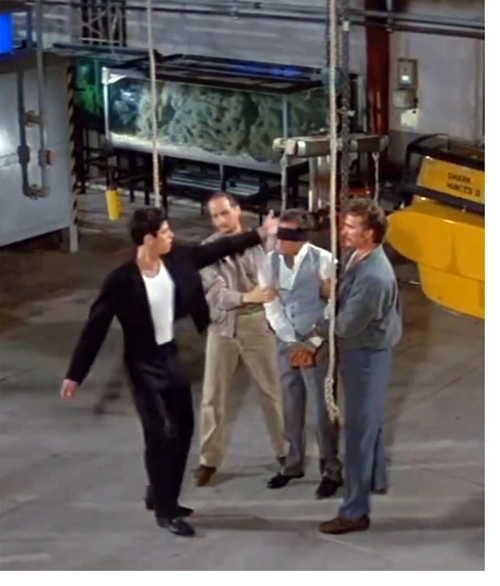
The premise is flimsy enough: Columbian gangsters torture Bond’s ally, Felix Leiter, on his wedding night and murder his bride, catapulting our man 007 into a personal vendetta as he goes after the kingpin, drug baron Franz Sanchez. The backdrop, we gather, or at least for those who still recall previous Bond films, is that the vicious death of Leiter's wife stirs the emotional wounds that still haunt Bond from the gruesome slaying of his own bride, Teresa di Vicenzo, in On Her Majesty's Secret Service. Unfortunately, this paltry allusion is hardly noticeable to contemporary audiences, most of whom (we can be virtually certain) have long forgotten this Bond movie from 1969. Nevertheless, the revenge angle is the sole plot mechanism for Licence To Kill, driving its unhinged hero through relentless vengeance, although it's nothing more than a convenient excuse for John Glen to orchestrate a series of action set pieces, all the while leaving the actors to meddle with the characterizations and dramatic interactions. As actress Carey Lowell explains in an interview for Cinefantastique, Glen’s “‘interest is really in the action. . . . He’s not really interested at all in the character’s history and he doesn’t want to discuss much of it. The acting sort of took second place to the special effects and the action and momentum of the story’” (Altman 26-28). In other words, forget the characterizations and just bang in a horde of action scenes. Character, character, clarify! are the words I imagine written in shaving cream on Dalton's bathroom mirror back at The Marquesa. Fortunately, the actor managed to pull some of the directorial reigns when it came to fleshing out the character aspects of the script and hit pay dirt with Lowell’s praises. “‘What John didn’t give me,’” the actress recalls, “‘Timothy did…. Luckily, Timothy was helpful because he’s very into character and ready to discuss it’” (56).
The film was less than stellar at the box office during the summer of 1989, and its underwhelming performance helped plunge the series into a moribund state, lacking any creative movement until its reinvigoration with GoldenEye in 1995.5 I still cringe at the mismanagement of the Dalton tenure, especially with Licence To Kill (although, strangely, I find the film more palatable than The Living Daylights). At the time, as the action film landscape changed with the onslaught of the Lethal Weapon series, Bruce Willis's Die Hard efforts, and the adaptations of Tom Clancy's spy thrillers, the keepers of the 007 film empire, although the pioneers of this sphere, lost sight of their franchise's uniqueness. In Licence To Kill, they gave us a film that lacked practically every element that made Bond endure: a thrilling caper in exotic locations, baroque villains, humor, romance, the brazen sexiness of women, and outright escapism. In the wake of Licence To Kill, the series was in a wasteland: there was silence on the production front and the shortcomings of recent Bond films—from A View To A Kill to Licence To Kill—only underscored how the series had become unglued. Empires have their rise and fall, and so it is with Emperor Albert R. Broccoli and his dominion.
Brief Encounter in Sloppy Joe's Bar
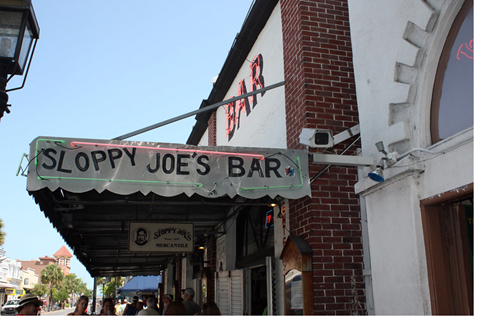
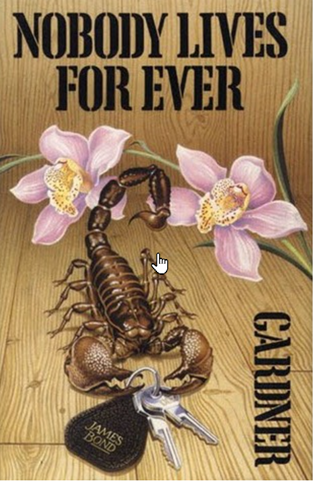
But now I was walking northwards, along Duval Street, still ruminating on this downturn in the series, when I noticed the dark blue dial of my Omega Seamaster diver watch (one must wear a Bondian watch in a Bondian location).6 It was 10:00 a.m. Sloppy Joe's Bar was scant yards away. Why Dalton's Bond never enters this famous pub remains a mystery. On the other hand, the literary Bond in Nobody Lives Forever, John Gardner's fifth attempt at a 007 novel, recalls the pub's importance in the Hemingway-Key West lore when he passes it during the drive to his hotel:
There was no doubt that Hemingway had lived in Key West. Even if Bond had not known it through reading To Have and Have Not he would certainly be apprised of the fact now, for many of the shops had souvenir T-shirts or drawings of Hemingway, while sloppy Joe's bar proclaimed the fact loudly, from an inn sign and a tall painted legend on the wall (234).
This occurs in the novel’s finale, where Key West becomes the endpoint for a series of chases, unfolding primarily across Europe, in a plot concerning assassination attempts on Bond, courtesy of a contract orchestrated by SPECTRE. The rationale for using Key West juts out awkwardly: Bond learns that, as mandated by the bounty rules, the winner has the honor to decapitate him by guillotine and to take the literal head of 007 to the new leader of SPECTRE, Tamil Rahani, who happens to reside on the sunny isle. I suspect Gardner threw in the Key West setting simply because, enamored by the place, he was eager enough to bring his own travel experience into the story. “I was ill when I was writing [the previous 007 novel], to the extent that I had to take six weeks off,” he explains in an interview for Bondage in 1985. “I hadn’t a holiday for six years, so my wife and I went off to Key West for a month, and sat, and went to sleep, and bathed in pools, and ate too much, and I felt much better afterwards.” This was during the writing of Role Of Honor, his fourth 007 effort, which the author struggled to write, even calling it “the weakest so far” in his continuation series (Schenkman “The 1985 Model John Gardner”).
In Nobody Lives Forever, Bond never enters Sloppy Joe’s; but Gardner’s brief account of the pub’s connection to Hemingway is admirable. The novel was published in 1986. Yet here I was, decades later, staring at the pub’s facade and hardly sensing any reverence for its famous patron. There was still an inn sign, quite small, etched with the author's illustration, that hung near the front entrance. If anything, the exterior resembled a rundown tavern. But inside, I found a clean well-lighted place with flags of other countries dangling from the ceiling and the late author's image embedded on the back screen of the stage (used for live music). Of course, just as depicted on the sign outside, it was the cliché image of an elderly Hemingway—white haired with a scruffy white beard—though he was in this thirties when he lived on the island. The historical inaccuracy, I must say, is part of the Key West syndrome: kitsch in the form of resort tackiness, blended with patches of luxurious hotels, tourist junk, art shops, restaurants, and the exploitation of a long gone writer whose works, though graced with familiar titles, have probably never been read by most visitors.
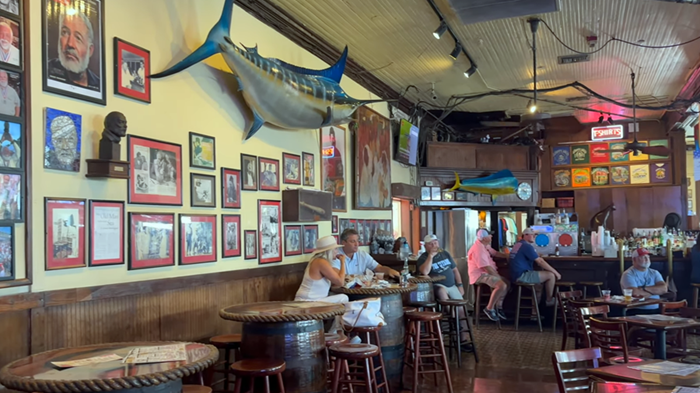
Inside, the bartender exuded a warm greeting, and I was faced with the problem of what to drink. In honor of Hem (the author’s nickname aside from “Papa”), it was suitable to order Scotch; but I was on a Bondian tour and, remembering Bond's drinking advice in The Man With The Golden Gun, I truly felt, at that moment, "the best drink of the day is just before the first one" (71). I settled for the Jamaican beer, Red Stripe, which Fleming's Bond savors frequently in the novel. An homage, then, to Fleming and to that Bond, and a nifty way to avoid the Dalton-Bond’s selection in Licence To Kill: in the Barrelhead Bar, he is too disinterested to drink (after sensing danger when Sanchez's thugs enter the joint) and quickly mirrors Pam Bouvier's preference for a “Bud with a lime” to end the protocol with the waitress. It's the segue into one of the main action set pieces of the film: whether John Glen and company were truly harking back to the film noir genre, as noted earlier, or even attempting to invoke a bit of atmosphere from Fleming's Live and Let Die is another matter. As presented, the bar room brawl downplays the luxurious settings often associated with the series.
Then again, the film struggles with a number of oddities. Above all, we’re treated to gruesome violence and incessant action without mysterious characters and an intriguing plot. John Glen runs through a checklist of action set pieces (skydiving, underwater battles, water skiing, flame throwing, bar fights, ninja attacks); and the Latin American drug smuggling scheme, pushed by a bland villain (regrettably, a misused Robert Davi), belongs in Miami Vice, not a 007 spy caper. Bond's reason for revenge, in which he loses professional objectivity, is based on his strong friendship with Leiter but it's implied loosely in the script and, consequently, lacks the concrete backstory that depicts how significant the friendship is for Bond, a friendship that, when threatened, would impel Bond to seek revenge. The veteran screenwriter for the series, Richard Maibaum, recognized this flaw and suggested, perhaps in his last interview, that it's difficult for audiences to connect with Bond’s motivation:
“‘In Licence To Kill, you didn’t get the feeling that there had been this close life and death relationship between Bond and Leiter. Somehow it didn’t come over, but it was our intention that it should. . . . It would have been better if there had not been so many Leiters [that is, actors who played the role], and if the audience had started out the picture with a very strong recall of the great camaraderie between Bond and Leiter, hooking it up with a face and a personality’” (Gross 90).
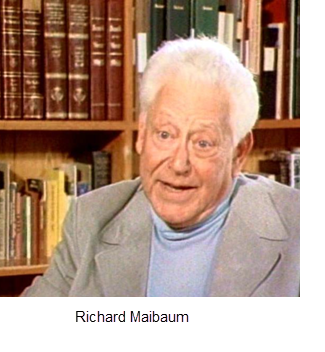
The atmosphere of the film is also inconsistent: the Olimpatec Meditation Institute (OMI), which houses Sanchez's cocaine processing, is a surreal setting, even fantastical with its futuristic architecture, which ultimately clashes with the grim sets in the first half of the film (for example, the marine warehouse and the seedy Barrelhead Bar). Once again, Maibaum expressed dissatisfaction with the OMI setting: “‘Personally, I didn’t feel that the meditation center came off clearly enough as to what exactly its function was, but once you get there, the action is so exciting, that you don’t care. . . . But this scene is so far out and fantastic, that it doesn’t really go along with the darker, realistic mood of the rest’” (Gross 90). The same could be said of the two songs in the film, the obligatory aria for the titles and the outro piece during the credits—both are too upbeat, pleasant, and lush to reflect the violent mood of the film. Better to have, in the title sequence, a haunting orchestral piece in the spirit of John Barry's composition for On Her Majesty's Secret Service, which would have also been effective as a reprise in the end credits to bracket the film with a distinct soundtrack theme.
The other major drawback is the underdeveloped plot point about Sanchez's intention to shoot airliners with stinger missiles unless the DEA forgoes his capture. Pam Bouvier summarizes the stratagem quickly in a hotel room during her confrontation with Bond. This is something the filmmakers should have worked into the main story, dramatized in full suspense: it would have been far more engaging to see Sanchez use those missiles in a sinister act than have the would-be operation muttered in fifteen seconds or so. It also would have taken the film beyond its simple drug smuggling ploy and into international terrorism, reinforcing Bond's revenge and justifying the involvement of the British Secret Service. As it is, this plot twist makes no impact, a problem that Licence To Kill also shares with The Living Daylights: in this first Dalton-Bond movie (also directed by John Glen), the plot twist foreshadows the Iran-Contra affair (profits of illegal arms dealing that finance a secret operation) but none of it makes any impact on screen because we never see it actually happen. It's not dramatized. Instead, we're given something meant to be intriguing through dialogue—a brisk explanation by Bond in the Afghan desert.
Back at Sloppy Joe's Bar, I heard somebody greet me as I took a swig at the Red Stripe beer.
"Hey, buddy!" The chap seated next to me, clutching a whisky glass, was smiling, while his wife leaned into view and raised her wine glass. "Cheers," they said, and we clinked our glasses.
"First time in Key West?" the man asked. Light from the window bounced off his red face.
"Yes,” I said. "But I've been to other parts of Florida. I even lived in Wellington."
"Nice. The equestrian paradise, "the man said. "But it's good you're here. Island time and all that. And don't forget our saying down here."
"What is it?"
"The locals are Conchs, and for good reason: we've been drinking." He laughed hard, almost spilling his drink. "I think it was Dave Barry who coined that phrase."
We introduced ourselves, and the round of pleasantries revealed that they were Morris and Ivy, originally from Vermont; that the Keys had always been one of their favorite getaways; that when they finally lost patience with the Vermont winters, in tandem with facing a new life as empty nesters, they decided to make the island life permanent.
I asked the obligatory question: "Were you here when Licence To Kill was filmed in the area?”
They barely remembered the sixteenth Bond film. They didn't even recall the Key West scenes; and they were still in Vermont when filming took place on the island.
"Sean Connery is the only Bond for me," Ivy said.
Her husband explained that the last Bond film they'd seen "had a tank crushing cars—wasn't that in Poland?" He mentioned that his great grandfather was from Warsaw and babbled about Bobby Vinton and how the singer was always proud of his Polish heritage. He raised his glass and started humming the chorus to "Polish Melody Of Love.”
The bartender interrupted the glorious recital. “Licence To Kill is the one with—wait, I was going to say Schwarzenegger but I'm thinking of True Lies.” He uncapped another bottle of Red Stripe for me. “There were action scenes with Jamie Lee Curtis on the Seven-Mile Bridge. But the Bond movie was before I moved here. I heard some scenes were shot in the area. I remember a Coast Guard officer who said he was an extra.” He smiled. “You're the first customer in a long while who mentioned that movie. Usually, people ask about the Hemingway contest."
He was, of course, referring to the annual Hemingway look-alike contest, usually spanning three consecutive evenings in this very bar. It reminded me of the flimsy veneer that Key West has developed for Hemingway's works. Whereas Paris, Pamplona, and Venice have the aura of veneration for old "Papa"—aficionados can at least revere the plaques and busts of the writer, which commemorate his connection to those other places—Key West has sank into the commercialism and exploitation that I alluded to earlier: welcome to a world of kitschy Papa paraphernalia as vendors hock T-shirts, bottle openers, feline ornaments, and the like. Simply put, it's unabashed commercialism that "draws comparisons to that other favorite figurehead of Florida tourism" (Curnutt 3). The disturbing after effect: this carnival atmosphere detracts from the literary attention Hemingway's oeuvre deserves and paints Key West with the reputation of a not-so "serious" site of Hemingway study. It is, we must admit, a forgetting of Hemingway literature, not to mention the tormented man behind those pages, struggling with fears of insanity and drowning in alcoholism.
To have and have another
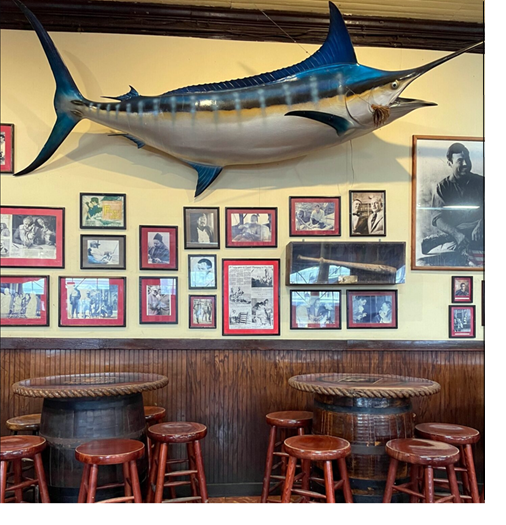
I got up from the barstool to look at the various photos and items on the walls. News clippings, framed Life magazine covers, and Hemingway photos covered the walls. More customers were streaming into the pub. There was the noisy laughter of drinkers blending with music from hidden speakers but I was staring at what the ravages of forgetting had left behind. The man and his works have long been eclipsed by commercial forces, so much so that, through the passage of time, this place called Key West had, in one sense, become a deep pit where his works have been thrown and forgotten. Even Licence To Kill, in this small community, is virtually forgotten. I drank down the rest of the beer, looked at Hemingway's picture hanging behind the stage. Already there was a shaft of dim sunlight spraying through the front windows of the bar. There, in the midst of the noise, I had the strange feeling of death that haunted me back at the Fontainebleau in Miami. I looked at the people but their faces became obscure in the faint light. One by one, we were all passing figures, turning into shadows. We suddenly exist, after an eternity of not existing, and we will again not exist, returning to that eternity from which we came. To hell with it, I thought as I sensed the bar becoming cool and dark and deep like a tomb.
In this mood, I ordered a shot of Haig & Haig (as commemoration to Hemingway), which Bond also savors with Felix Leiter in Live and Let Die. In a cottage in the Everglades, Leiter greets the British agent and his girl du jour, Solitaire, and brings out a bottle of Haig and fetches "some soda water and they both took a long drink" (114). Hemingway, in a more intense bacchanalian spirit, was seldom without a glass or a bottle of something in his hand, downing just about everything, from cocktails to Champagne to beer to whiskey, although by the late 1930s, with overhanging physical decline, he was quite health-conscious to limit himself to a measly three Scotches before dinner. Not surprisingly, his characters seek such drinking revelry and would have enjoyed the company of Bond and Leiter. Take, for example, Jake Barnes in The Sun Also Rises, who shares whiskey (by which Hemingway probably meant Scotch) with his wimpy sidekick, Robert Cohn, in a pub in Paris in the middle of a workday:
Anyway, we went down-stairs to the bar and had a whisky and soda. Cohn looked at the bottles in bins around the wall. "This is a good place," he said.
There's a lot of liquor," I agreed. (11)
And in "The Three Day Blow," during a rainy autumn evening in the northern Michigan woods, Nick Adams delves into a drinking fest with his sidekick Bill to seek refuge from a broken heart:
"Let's have another drink," Nick said.
"I think there's another bottle open in the locker," Bill said. He kneeled down in the corner in front of the locker and brought out a square-faced bottle.
"It's Scotch," he said. (121)
In turn, I took a swig from my shot glass, feeling the liquid lash at the back of my throat. Despite the touristy feel of the place, Sloppy Joe's had transformed into an atmosphere suitable for a pub philosopher: in my mind, the crowd faded away and, amidst the clatter of cups and glasses, I kept thinking about Hemingway, his fictional world, and this business about forgetting that even haunted the Bondian world of Licence To Kill.
Rambling thoughts in an existentialist pub

"Write the truest sentence that you know" (12), Hem proclaimed in A Moveable Feast. I gather his meditations on death had enough truth in his mind to deserve lengthy treatments in his works, even reaching a sort of metaphysical slant. For he was always preoccupied with death. The sport of the bullfight, for example, is reworked in his tales as a ritual to confront death and to do it well with bravado in the so-called stance of grace under pressure. Life, as always, is too brief for anything; but the individual has the potential to outdo death through courage, a stance where one asserts human dignity despite the inevitable. This gives the individual a chance to get the better of death, reducing it to a servant of sorts, making it succumb to one's bidding, ritualizing the act of killing so that death becomes something to conduct just as a conductor leads an orchestra. The terrifying landscape in much of Hemingway literature—the bullfighting ring, a battlefield, a fierce ocean, or the African wilderness—serves as the backdrop for this esoteric state of death. It's the landscape where the individual stands in that arcane twilight between life and imminent death, where time and place become pointless concepts at that moment, along with politics, culture, tradition, even religion—structures, if you will, that become superfluous, even trivial, at the threshold of the overpowering plight: the necessity to exist, and to do it with dignity.
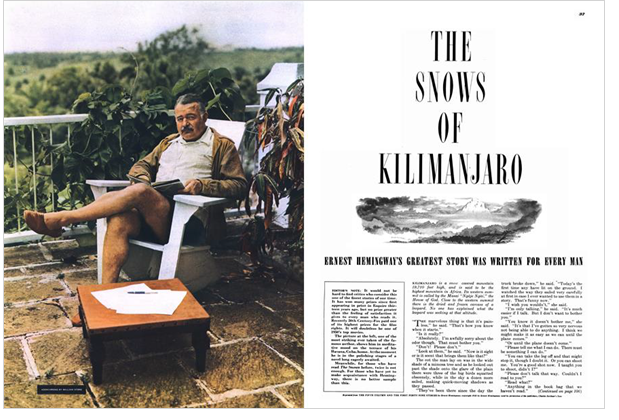
So we have the ever-presence of death in "The Snows of Kilimanjaro" under the guises of hyenas, lurking just outside the protagonist's tent, and the stench from his gangrened leg as he lies on a cot. Here he is, Harry (his last name is never revealed), near the end of the tale, with a high-resolution view of death:
Because, just then, death had come and rested its head on the foot of the cot and he could smell its breath.
"Never believe any of that about a scythe and a skull," he told [his wife, who is sitting by the firelight]." It can be two bicycle policemen as easily, or be a bird. Or it can have a wide snout like a hyena."
It had moved up on him now, but it had no shape any more. It simply occupied space. (74)
Or this damn thing called death could come under the guise of a poisonous centipede, as depicted in Doctor No, when the creature crawls on Bond's body while he's in bed. This scene always struck me as inspired by the tent scene in "Kilimanjaro," with death creeping slowly towards the hero. Whether this was Fleming's intention is unclear: in Fleming, we risk walking the narrow line between determining the extent that he's striving for "literature” and whether to drop the analysis and accept his fiction as pure escapist fair, unfit for the belles-lettres category. Umberto Eco explained this aspect of the Fleming works as nothing more than the collection of the man's experiences and his readings that "may have worked in the mind of the author without emerging into consciousness" (169). In any case, by the time Fleming wrote Doctor No in 1957, Hemingway's "Kilimanjaro" was firmly established as one of his best known short stories. First published in Esquire in 1936 and later included in the 1938 compilation The Fifth Column and the First Forty-Nine Stories, the short story is one of Hemingway's major works, reinforcing his forte for a richly layered narrative cloaked in sparse, minimalistic prose.
Meanwhile, Fleming (ever tongue in cheek) had a knack to adapt, or at least emulate, some elements of famous literary works that he sniffed in the air, so to speak, to enliven his writings as, one could say, synthesized literature. Hence, we get Blofeld's allergy clinic on a Swiss mountaintop, which reflects the sanatorium in Thomas Mann's Magic Mountain (1924). The obstacle course that Bond undergoes in Doctor No's island lair has shades of Zaroff's scheme to hunt shipped-wrecked survivors for sport in Richard Connell's "The Most Dangerous Game" (1924). Most of all, the good doctor is not only a Fu Manchu redux—a tall, lean nefarious Chinese scientist, draped in a long kimono, sporting a shaved head and pincers for his hands—but a variation of another mad scientist, concocted by H.G. Wells, one Dr. Moreau who just happens to be the proprietor of an island. In Verne, too, we find the antecedent to Doctor Julius No: Captain Nemo, another demented scientist seeking revenge on civilization, spends his days in a glorious submarine, the Nautilus, watching the undersea life through the vessel's thick lenticular window—just as Fleming's villain seeks refuge in the underground facilities of his island, admiring the view of the undersea from a spectacular armored glass wall. Other similarities abound: take, for example, the Orient Express train in From Russia, with Love, which is clearly inspired by the popular Agatha Christie mystery; and, moreover, the notion of a train rendezvous with mysterious characters is something of an archetypal literary motif, even finding its place in The Idiot (no, not a biography of Sam Mendes). In the opening of this 1869 novel by Dostoyevsky, three offbeat characters on a train to St. Petersburg discuss the joyful topic of how people react to the knowledge that they are about to die.
In “Kilimanjaro,” we frequently encounter Harry's feelings through stream of consciousness, a technique that Fleming also happens to use in the aforementioned deadly centipede scene. As Bond lies in bed, he realizes he's on the verge of death; that his life—underscored by the pulse of his beating heart—could end any moment:
Whatever happened he mustn't move, mustn't even tremble. . . . But now the thing was turning up and along his stomach. Its feet were gripping tighter to prevent it falling. Now it was at his heart. If it bit there, surely it would kill him. . . . What was it looking for? Was there room between his skin and the sheet for it to get through? Dare he lift the sheet an inch to help it. No. Never! The animal was at the base of his jugular. Perhaps it was intrigued by the heavy pulse there. Christ, if only he could control the pumping of his blood. Damn you! Bond tried to communicate with the centipede. It's nothing. It's not dangerous, that pulse. It means you no harm. Get on out into the fresh air! (Doctor No 65)
It's a well-crafted scene, the suspense heightened by the beating heart (the pulse of life) and the crawling poisonous centipede (death), expounded through a man's thoughts as he grasps for survival. Only moments ago, he woke, realizing it was three in the morning, and sensed an eerie stillness: "There was not a sound in the room. . . . Outside, too, it was deathly quiet. Far in the distance a dog started to bark. . . . The moon coming through the slats in the jalousies threw black and white bars across the corner of the room next to his bed. It was as if he was lying in a cage" (64). That tranquil moment—wherein Bond was safe, alive—suddenly disappears. There one minute and gone the next. Life is tenuous, a steady stream of uncertainty, though leading to the paradoxical conclusion in the certainty of death. Death in itself is the ever present outcome that lurks before us—whether you're a secret agent whose enemies have planted a poisonous centipede in your bed or a big-game hunter in the African plains who suddenly faces his demise from a gangrened infection. The moment of death is uncertain, indefinite. Yet its inevitability is here, in the present. Here's Bond, a few years before the Doctor No mission, coming to terms with death on a flight to Jamaica during a powerful storm:
They were flying at 15,000 feet when, just after crossing Cuba, they ran into one of those violent tropical storms that suddenly turn aircraft from comfortable drawing-rooms into bucketing death-traps. . . . [Bond] looked at the racks of magazines and thought: They won't help much when the steel tires at 15,000 feet . . . [and] the little warm room with propellers in front falls straight down out of the sky into the sea or on to the land, heavier than air, fallible, vain. And the forty little heavier-than-air people, fallible within the plane's fallibility, vain within its larger vanity, fall down with it. . . . (Live and Let Die 150-152)
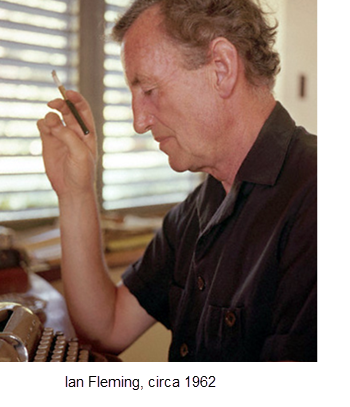
Every moment is death-in-life, Fleming suggests as he pounds on his typewriter in Goldeneye, sometime in January 1953 during the writing of this novel, while puffing on probably his 70th cigarette of the day, the smoke drifting upwards in small clouds, the signals of his own mortality. Again, he gives us the precariousness of life: at one moment, Bond's flight was pleasant; the next moment, he faces the likelihood of death. This is the condition that haunts every moment. In the turbulence of life, nothing can be relied upon for security. As soon as you attain something, it's gone. But added to the mix is this pestilent element of anxiety, a condition that surfaces when our transitory state gives us the gnawing tenor of unease as we face what we're thrown into: despite the uncertainty, we still have to carry on with the business of living—to make the most of it, to make it all worthwhile and significant. Each of us, as implied through these characters from Hemingway and Fleming, confronts the task of being responsible for one's own existence. But such responsibility, in the presence of death, makes this contingent existence anxiously felt as a burden—the overwhelming burden to create an effective life. The opposite—the avoidance of this burden—erases any substantial dimension, thrusting us into weightlessness, insignificance, an unreal region best expressed (in Kundera's almost magical phrase) as an unbearable lightness of being.
Sound familiar? It should. These bits of philosophical babble derive from the playbook of existentialism and, well, the hard-hitting disillusionment of the post-World War I generation, eventually tagged as the so-called Lost Generation. Hemingway was engrained in this milieu; and, as Sartrean existentialism was still in vogue during the publication of the 007 novels, it seems Fleming was clinging to the coattails of such sentiments. The trail blazers, such as Hemingway, introduced a modernist experiential revolt: renouncing post-Victorian conventions, it was time to seek entirely different values. For Hemingway, it was a type of conduct that could assert human dignity in a transitory, godless, and ultimately futile existence. Hence, the coming of the Hemingway hero: the self-reliant, brave, sort of stoic individual, a free spirit who craves adventures and physical pleasures—the traits essential to embrace the agony of life in its fullest. This translates into hard-drinking characters roaming foreign places, bacchanalian types (as I touched upon earlier) as reflected in prose that offers much attention to what they consumed and drank and savored in the world. The approach is suspiciously reflected in the pages of Fleming, a sort of template for his Bond: a spy is born, who happens to be a self-determined type, carousing in the now familiar 007 high-style of living, yet in accord with existentialism's emphasis on the individual's freedom, where one moves through the world, embracing the understanding that he's on his own, unrestrained to determine himself through the very act of the freedom to choose.
For whom the boredom tolls
We also cannot leave out the underlying disturbing thing: a sense of boredom for these characters—profound boredom. Boredom as emptiness. Boredom as the basis for insignificance, powerlessness, in one’s life, converging into restlessness, a persistent nagging that haunts meaningless living. The old traditions have been abandoned; the new ones, whatever they are, would be a set of values to live by. Adrift, aimless in their wanderings and in their Bacchanalian lifestyle, these characters grapple for significance in their lives. This condition smacks of the brooding thoughts of that one chap—what was his name?—who wrote in bizarre pseudonyms and shook nineteenth century Danish Christendom with staunch criticisms of institutional religion and thrust troubling notions about boredom onto a self-assured society; namely, that we find ourselves in one distraction after another to prevent us from seeing the vacuum of our existence. We pursue pleasure, novelty, even ideologies, because the real misery in our lives is boredom. Thus spoke Soren Kierkegaard.7
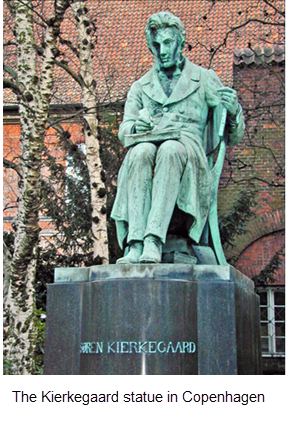
To which T.S. Eliot echoes in his meditation on empty lives in “Burnt Norton”: we are people with “strained time-ridden faces / Distracted from distraction by distraction / Filled with fancies and empty of meaning” (100-103). To our astonishment, we suddenly exist, preceded by an eternity where we didn't exist and bound for another eternity where we will again not exist. In this gap between two eternities of nothingness, life presents itself as a task: to do something with it to ward off boredom. How would we occupy our lives, how would we pass the time? All it takes, then, is to fill the void with distractions. The alternative—standing before the emptiness—is unbearable to confront.8 In Fleming’s fiction, Bond certainly has enough distractions to fill the drabness in his life when he’s not on assignment abroad. In Moonraker, we get a glimpse of his boredom when the Bondian life lacks globe-trotting missions:
It was only two or three times a year that an assignment came along requiring his particular abilities. For the rest of the year he had the duties of an easy-going senior civil servant—elastic office hours from around ten to six; lunch, generally in the canteen; evenings spent playing cards in the company of a few close friends, or at Crockford’s; or making love, with rather cold passion, to one of three similarly disposed married women; week-ends playing golf for high stakes at one of the clubs near London. (9)
It’s a fixed routine for this “easy-going senior civil servant,” which is nothing more than a high-sounding term for a government bureaucrat. His evenings of playing cards with his cronies suggest that Bond doesn’t have other interests outside of Her Majesty’s Secret Service. It’s a drab existence heightened by the meaningless adultery with “one of three similarly disposed married women,” who are obviously trapped in dead marriages, a condition that points to meaningless lives and the urgency to rectify the inanity with something, even if it means “cold passion” from a similarly bored civil servant. One is tempted to think that Fleming brought into Moonraker a 1955 version of Les Liaisons Dangereuses, wherein the underlying worry in life for its characters is boredom in their hollow lives, leaving them with nothing left to do but, shall we say, delve into animalistic copulation.
In Moonraker, the summary of Bond’s boredom links to the early scenes of the novel that depict the drudgery of office life. The elevator ride to the eighth floor of the Secret Service building is something of a passage to monotony. On this Monday, Bond steps into the “drab Ministry-of-Works green corridor” and into the bureaucratic grind with “girls carrying files, doors opening and shutting, and muted telephone bells” that emphasize the “routine day at Headquarters” (5). For Bond, “Mondays were hell.” It would also be “Two days of dockets and files to plough through” (6). Years later, in “The Property Of A Lady,” one of the tales in the Octopussy collection, we find Bond in a dour mood in his office as he wades through routine paperwork, struggling again with the dreaded malaise: boredom. “There was no sign of any work to be done,” he realizes. “All over the world there was quiet” and that he “hated these periods of vacuum” (97-98). This from the man who, in strange antics, sets his own regimented routine, exemplifying a fastidious autocrat at the breakfast table, as he demands a fresh speckled brown egg from French Marans hens, boiled for three and a third minutes, and insists it must be placed into a Minton egg cup, next to the Queen Anne coffee pot and silverware on the tray. This is the Bond in From Russia, With Love, who wakes in his flat off Kings Road, feeling “throughly bored with the prospect of the day ahead.” The boredom—his boredom—is the catalyst for self-destruction: later in the scene, as he starts his drive to the office, a twisted quotation about boredom amuses him as he recalls that “Those whom the Gods wish to destroy, they first make bored” (97).
Not quite right, as Bond presumes. The line, in its Latin treatment, appears as Quos Deus vult perdere, prius dementat, which translates to Those whom God wishes to destroy, he first deprives of reason.9 In other words, the first step to one’s destruction is a descent into madness. On the other hand, all it takes is boredom, as Bond seems to say, to reach a death-like state. On that morning in From Russia, With Love, as he lies in bed waking to boredom, his musings lead to his conviction that, just as accidie is the first cardinal sin, “so [is] boredom, and particularly the incredible circumstances of waking up bored,” which is the only vice he “utterly condemned” (91). Thus, the antics at the breakfast table could be looked upon as an attempt to escape from the blubbery arms of boredom. Fill one’s life with flash, so to speak, to cover up the emptiness. In this sense, Bond has thrust distractions into his life, filling it with fancies. Distracted from distraction by distraction. We are back to Eliot’s haunting view of modern life.
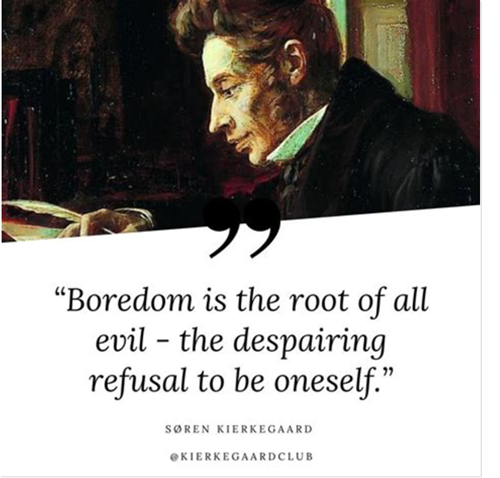
It also takes us back to Kierkegaard: these glimpses into distraction remind us of his enigmatic, yet alarming line that “one need only consider how ruinous boredom is for humanity” and that, ultimately, “boredom is the root of all evil” (281). We delve into pleasures, trivialities, principles, beliefs of all sorts, because the reality of evil, or the real misery, in our lives is boredom. It’s nothing more than the struggle to grasp onto something—anything that would bring significance into one’s life—that would fill the void of boredom. Yet more dangerous than greed, the depth of evil introduced into the world stems from our simple desire for sensation.10 The stance of the megalomaniac Mr. Big, in Live and Let Die, certainly accords with this Kierkegaardian view. In his first encounter with Bond in his lair beneath a Harlem night club, he states (emphasis from me),
“Mister Bond, I suffer from boredom. I am a prey in what the early Christians called “accidie,” the deadly lethargy that envelops those who are hated, those who have no more desires. . . . . I have, literally, no more worlds to conquer within my chosen orbit. . . . I take pleasure now only in artistry, in the polish and finesse which I can bring to my operations. It has become almost a mania with me to impart an absolute rightness, high elegance, to the election of my affairs. Each day, Mister Bond, I try and set myself still higher standards of subtlety and technical polish so that each of my proceedings may be a work of art, bearing my signature as clearly as the creations of, let us say, Benvenuto Cellini” (65-66).
So his demented manifesto proclaims his nefarious schemes as works of art. Thanks to his boredom, Mr. Big obviously has nothing better to do except offer the world violence, destruction, and death that, as a sop to his self-interest, represent something of a higher order. Moreover, it’s only fitting that he likens himself to Cellini, who wasn’t exactly an upstanding citizen of Renaissance Italy, considering how he was plagued by accusations of embezzlement, sodomy with young boys, and even the murder of a rival goldsmith.11 But at the very center of Mr. Big’s credo is the core mentality of the megalomaniac Bond villain: boredom, powered by the simple desire for sensation, fuels malevolent thoughts and unleashes chaos into the world. Auric Goldfinger’s obsession with gold, Doctor No’s mania for power, and Ernst Stavro Blofeld’s constant impulse to dominate the world all point to this underlying existential state. “But there has developed in me,” Blofeld explains to a captured 007 in his castle in You Only Live Twice, “a certain mental lameness, a disinterest in humanity and its future, an utter boredom [emphasis mine] with the affairs of mankind.” 12
Hence, he offers the world a magnanimous service—provide “free death,” as he calls it, “to those who seek release from the burden of being alive.” The macabre atmosphere of his island, verdant with poisonous tropical plants and deadly animals, serves as a garden of death, attracting people who seek suicide. Through his credo, he provides “the common man with a solution to the problem of whether to be or not to be,” which is, as he proclaims, “far from being a crime,” leading instead to “a public service unique in the history of the world” (You Only Live Twice 146). Thus, Blofeld’s boredom compliments the boredom of those who, fed up with the “burden of being alive,” seek the ultimate distraction in their empty lives—suicide. Kierkegaard’s words, one need only consider how ruinous boredom is for humanity, resound in Blofeld’s castle.
In Bond’s case, the business of living gains significance only when there is action, usually manifested in the pursuit of a Blofeld or an Auric Goldfinger. For him—“a man of war” (91) as Fleming adamantly states in From Russia, With Love—a dangerous mission and its spectre of death provide a deeper experience of being alive. One could draw a parallel of this condition to the epiphany of the Hemingway hero: the individual who goes beyond the meaningless carousing and finds significance in the encounter with death, with its profound experience and all the other quasi-metaphysical shibboleth expounded by Hemingway.
Back at Sloppy Joe's, I finished another round of Haig and got up from the barstool.
The bartender leaned on the counter. "There's a long-time understanding about this place. It's not the original Sloppy Joe's where Hemingway drank. The real one is just off Duval. On Greene Street. It's now called Captain Tony's Saloon."
The bartender offered another round of whiskey.
"No thanks," I said. "For now, it's a farewell to booze."
We laughed and shook hands and I walked to the door in the midst of raucous voices and the clinking of silverware, plates, and glasses. Outside, pedestrians and cyclists streamed casually in the bright sunlight. I looked up at the inn sign at the front entrance one last time, noting its embedded illustration of the elderly Hemingway, and shuddered as I remembered the most disturbing image of the author: white-haired, withering in mental illness, he leans over a double-barreled shotgun in the dark early hours of July 2, 1961 in Ketchum, Idaho.13
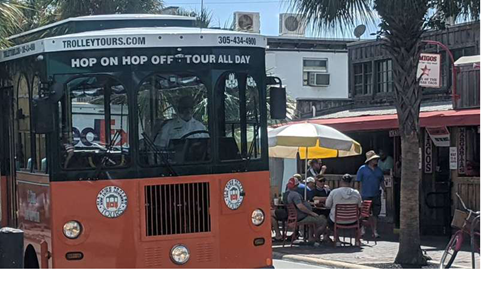
Immersed in this trance, I walked to nearby Simonton Row, a trolley boarding location, at the corner of Simonton and Greene Streets. It was another hot spot for tourists because of its many restaurants, shops, and the Ripley’s Believe It or Not Museum. I hopped on a trolley (recommendation: buy, in advance, the one-day ticket of unlimited boarding) and sat at the back, leaving behind the faded moment of whiskey glasses and philosophical brooding in a legendary Key West pub.
Landmarks of Licence To Kill
The trolley moved southwards along Duval Street. My goal was to get off at South Street and stroll to the house that served as Felix Leiter's residence in Licence To Kill. John Gardner, in his novelization of the film, describes it as a “delightful gingerbread house which had cost [Leiter] a fortune, his entire CIA kiss-off money together with the accrued interest” (21). Located in the Casa Marina neighborhood, the house has a sprawling look accented by lush palm trees—not at all a quaint cottage, or a gingerbread house straight out of a fairy tale. I stood on the side walk, risking the appearance of a stalker; but out of respect for the owner’s privacy, I didn’t take photographs.14 Apart from the house address (hanging above the front door) designed as a tribute to the 007 logo, the porch and columns and the white vinyl sidings still resembled the facade of the house in the film. There was a time when Timothy Dalton, David Hedison (as an improbable Felix Leiter), and Priscilla Barnes (miscast as Leiter’s bride) stood on this very porch to film the scene wherein Bond bids the newlyweds farewell.15 Approximately 27 years ago, sometime in the summer of 1988, the cameras rolled to capture the scene; and now all that remains, circa December 2015, is the fixture of the 007-style house address (a cheeky touch by the owners) to evoke a remembrance of Bondian things past.
A middle-aged woman was walking along the sidewalk with her little dog and greeted me. “Let me guess. You’re a James Bond fan?”
“Yes. And just admiring the house.”
She looked at the front porch. “The fans come around, sometimes. But not enough to disturb the neighborhood.” She lived down the street and hadn’t seen Licence To Kill in a long time and wondered if the house was prominent in the movie.
“I’ll have to see it again,” she said as she tugged the leash gently to prevent the dog from trotting away. “Not sure about the last Bond movie I saw. There was one with an invisible car. How long ago was that one? Is that the one where Bond and a girl are lost in a desert? Correct me if I’m wrong, but it was Quantum Factor, I think. Did I get the title right?” she laughed. It had ‘quantum’ in the title.”
Well, cheers to her for even remembering fragments of Bond movies. In the speed of this world, where events come and go, each one is forgotten quickly, fading in the thick mist of a collective amnesia. From across the street, a lady in a Christmas sweater (of course, the hideous kind, bright green, emblazoned with an enormous Yeti sporting a Santa hat) walked over and greeted us. The two women chatted, babbling about how Christmas had flashed by like a meteor, and the dog started barking. I sensed this other woman did not know about the Bond films, considering her indifference when the first lady explained I was having a look at the Leiter house. As I stood on the sidewalk, with these two chatterboxes and the barking dog, Key West suddenly felt like a city without memory. Nobody remembered its past, nobody recalled anything or the cultural aspects of its history—be it Hemingway or the Fleming/Bond connection. I spent a few more moments looking at the front porch of the Leiter house.
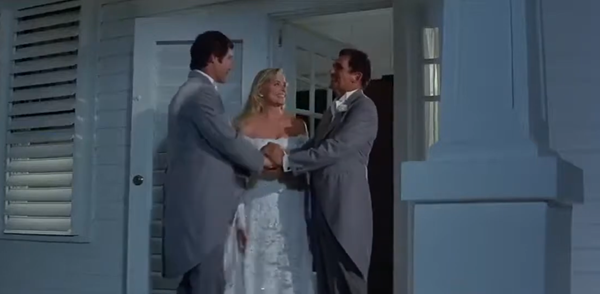
If there was one thematic element that the filmmakers captured from the Fleming books, it’s this notion of transitoriness. At one moment, Leiter and his bride are on the front porch in bliss, ready to forge a new life together. Seconds after their farewell to Bond, their life is disrupted as they face the horror of Sanchez’s revenge. Likewise, in the Fleming books, events change quickly: Bond, for example, feels the oceanic rapture of his own wedding at the end of On Her Majesty's Secret Service, only to lose it all in a matter of moments when his bride is gun-downed by archenemy Blofeld. Each instant is a universe of its own, a horde of events, a rainfall of thoughts and feelings coming and going, yet irrevocably erased in the next moment. Throughout literature, the perennial matter has always stood out: how to depict, capture, the present moment, which always eludes us? How to make it more tangible, palpable? Joyce, for example, did it through stream of consciousness that he infused in his characters: the cavalcade of sensations and ideas passing through his characters’ minds are all laced in a complex narrative based on the flux of their thoughts. For Fleming, it was describing details of objects, consumer brands, and so forth, to ground the fictional moment in something concrete—aspects of journalistic reportage, of course, a testament to Fleming’s background as a correspondent, and one of the key characteristics of the Fleming books, coined by Kingsley Amis as the “Fleming effect” (100); yet it reminds us of an attempt to concretize the moment that Fleming is describing. Hence, not only does Bond use any cigarette case but a black gunmetal case, which holds his custom Morland cigarettes. Regardless of technique, the intention is the same: the author places a microscope over the fictional narrative to stop, or at least slow down, that fading moment to help us see it.
Somehow I pulled myself away from the sidewalk raucous: I remember waving goodbye to the women, who were now in a cage of confused babble as they each spoke into their respective mobile phones, drowning each other out with their voices, while the dog continued to bark. Fifteen minutes later, after a brisk walk, I was standing in front of St. Mary's Star of the Sea Church, officially a basilica and used as the church for Leiter’s wedding. Located at the corner of Truman Avenue and Windsor Lane, the church was about half a mile from the Leiter house. I recognized the three arches at the front entrance where the wedding entourage and guests were waiting for Bond and Leiter to arrive. In the novelization, the church is described as “St. Paul’s Church on Duval Street,” presumably derived from the script and to which John Gardner implies the ironic mismatch of the locale: the street is “better known for its bars and restaurants than the church” (3). Gardner was obviously referencing the episcopal church at 401 Duval Street. The filmmakers, however, avoided any references to a specific church but, as widely documented, they filmed the front of the aforementioned basilica instead.
One wonders if such discrepancies stem from the madness that John Gardner encountered during the writing of the novel. In an interview with Raymond Benson, the author states that the endeavor was a “one-off idea, and I thought it might be fun.”16 Instead, he describes the writing process as something of a nightmare:
I did it but I wouldn’t want to do it again. . . . I started working on it and the screenplay changed daily. I would get phone calls saying, “John, scenes 230-235 are out, and new pages are being couriered to you.” It drove me mad. I also had to pad out the book a bit. There are huge jumps in the screenplay, which you can do on screen; but with a book you need to explain things. So I had to add a lot to explain how Bond got from here to there, that sort of thing. (“Gardner’s World” 38)
Also implicit, in both the film and novelization, is that Leiter, Bond, and Sharky (a local fisherman) had been on a different Key the night before the wedding, considering that they are traveling to the church by limousine along the Seven Mile Bridge in the opening sequence. It concludes with quite the extravaganza: Leiter and Bond, after suspending Sanchez’s Piper Cub under their helicopter, parachute to the church in one of the film’s rare Bondian moments—the aerial cinematography, pacing, editing, the soundtrack (an orchestral arrangement of the 007 theme in a slow dramatic cadence), and the overall spectacle of the stunt evoke the Bondian atmosphere. The parachute stunt was overseen by B.J. Worth, a key member of the stunt team since Moonraker, the eleventh film in the series in which he coordinated the pre-title stunt featuring Bond falling out of an airplane without a parachute.

As I stood at the front of the church, I looked up at the blue sky and recalled that the filming of the sky-dive, as described in The Making Of Licence To Kill, had its own challenges. The FAA had mandated that if a lightweight plane was winched beneath a helicopter, the flight path would have to be cleared for safety reasons. The filmmakers also caused inconvenience for the locals by “turning off the electricity in the area (to avoid the parachutes getting entangled with power lines) and closing some of the roads to allow filming to take place” (23). Meanwhile, the second unit had the helicopter circling approximately 3000 ft above the target to make the sky-dive last five minutes. The stuntmen reached the landing spot in front of the church on the first attempt but strong winds prevented them from landing together as described in the script. This was adjusted through slick editing by showing Leiter landing first and embracing Della Churchill, followed by a cut to Bond, who lands approximately near the same spot. In the novelization, the groom and his best man arrive “almost three hours late,” while the “future Mrs. Leiter went around [the church in the wedding limousine] four times in a crawl” (20-21). On screen, however, the illusion of film editing conveys a brief time span for these events, and the lack of anger and frustration from Della and the guests suggest they hadn’t waited too long. I stood on the sidewalk and looked back at the front area, attempting to visualize the cast members and extras milling near the entrance as Bond and Leiter arrive. It’s a compact area for parachute landings, considering the proximity to the sidewalk and the street. In retrospect, not only is the stunt a marvel to behold but the sheer fact that it had been performed successfully in such narrow confines points to the exceptional work of the Bond crew.
Not far from me, an old man was sweeping leaves from the wheelchair access ramp. The chap was friendly enough to babble about the history of the church but was unaware of the church’s place in Bond lore. He encouraged me to pray at the grotto and to visit the Adoration Chapel and the gift shop. Instead, I roamed the grounds, absorbing the essence of the place and snapping photos. The church itself was built in 1904 but the original wooden version was destroyed in a fire in 1901. The plaque on the lawn is never seen in the film—again, a testament to the filmmakers’ efforts to present a nondescript church. Likewise, its interior is never shown. Instead, we see Leiter and Bond enter the church through the front door, with their parachutes still attached to their morning suits, while the familiar melody of the “Bridal Chorus” from Wagner’s Lohengrin blasts from a pipe organ, a smooth segue into the intro of the title song—a variation of the opening bars of Goldfinger—as the scene itself dissolves into the title sequence.
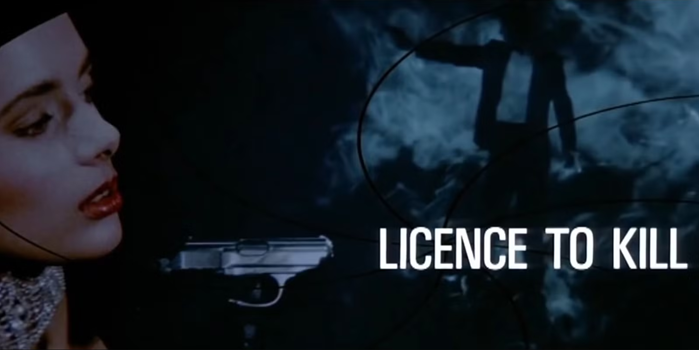
The late Maurice Binder, in his final contribution to the series, treads into familiar imagery in his title design. Once again, we’re treated to tired palettes of silhouetted nudes, gambling and gun motifs—that and an out-of-place montage of actress Diane Hsu (who also has a fleeting role as a Hong Kong narcotics agent) in ballerina-like choreography, leaping in a slow motion soft focus effect to the lush muzak arrangement of the title song’s chorus. It’s another formulaic attempt to hark back to the atmosphere of the Goldfinger/Diamonds Are Forever title sequence that emphasizes a scintillating, cinematic song with sensuous silhouettes of women. But the song for Licence To Kill is too mediocre and annoying to be alluring, and the Binder imagery is too bland and annoying to be eye-catching, a combination that is ultimately in complete contrast to the grim mood of the film.
One of the key scenes of grimness is Bond getting his so-called licence to kill revoked (hence, the rationale for the title).17 This is, in essence, the dramatic centerpiece of the film, showcasing the hero we’ve seen since Dr. No lose the famous Double-O status and, consequently, becomes a rogue agent, the blue print for subsequent 007 films, especially the vacuous Craigian tenure. Not surprisingly, the scene occurs at the Hemingway house on 907 Whitehead Street: with Key West as a locale, it was obligatory for the filmmakers to use the landmark in some capacity. Moreover, it’s a fitting place for the M/Bond confrontation where Bond quips, “I guess it’s a farewell to arms,” as he turns in his Walther PPK to complete his resignation. I suspect such a clever remark—an allusion to the Hemingway novel while apt for Bond’s situation—could only come from Richard Maibaum, the pioneer of the cinematic Bondian wit. Composer Michael Kamen offers a slow somber arrangement of the 007 theme as M tells Bond, “Effective immediately, your licence to kill is revoked. And I require you to hand over your weapon.”
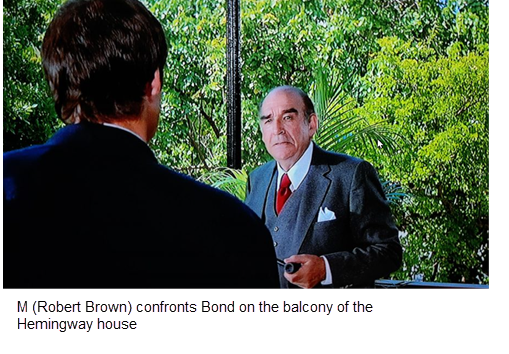
It’s the most interesting scene in the film: genuine tension exists between Bond and M, the phrase “licence to kill,” long associated with the series, gains significance, and the revocation of the Double-O status is underscored by Bond pulling out the Walther—the symbol of his licence to kill—and his nod to the Hemingway title, which reinforces the relevance of their location. Robert Brown is a suitably bureaucratic M, a staunch civil servant of Her Majesty’s government, while exuding the authoritative Churchillian demeanor of the character in the books, although the notion of the MI-6 leader personally flying to Key West to admonish Bond is preposterous. In the novel, Gardner attempts to justify the situation by having the character explain his visit to Bond (emphasis from me): “You were supposed to be in Istanbul two days ago. It was important to your Queen, your country and the Service. That’s why I’ve bothered to spend Lord knows how many hours on aircraft, to come to this tacky little showplace.” (72). For some reason, director John Glen never included these extra lines of dialogue in the scene. He also misdirects Dalton: Bond is too angry without making a hard attempt to convince M why he needs to stay in Key West. More surprisingly, in the actor’s delivery of the line “ Sir, [the Americans] are not going to do anything,” he comes across as a whining child. Why Dalton and director Glen didn’t rectify this oddity is a mystery. Yet on the whole, the scene’s tension is taut and engaging enough to overcome its shortcomings. The scene ends with Bond glancing at the lighthouse across the street (where an MI-6 sniper is positioned) and leaping over the handrail of the terrace to escape.
Back at the church, I could see the lighthouse from the sidewalk. The old man, clutching his broom, said that the Hemingway House was less than half-a-mile from the church. I glanced down at the Omega watch. It was 11:10 a.m. It was time to meet the Anonymous Gang at casa Hemingway.
A whisper of sorrow, a whisper of solitude
The house, at the corner of Whitehead and Olivia Streets, is open daily. Not surprisingly, and considering the amount of tourists I’ve seen throughout the morning, the line for admission extended from the entrance to the sidewalk along Whitehead Street. But the line moved quickly and, at one point, the Anonymous Gang and I were positioned by the plaque at the gate of the house. Of course, I couldn’t resist explaining to my group that this plaque was a fleeting backdrop at the start of the Hemingway House scene in Licence To Kill. And, of course, my explanation was (once again) cooly received by said group. But we were, at that moment, at the spot where Dalton’s Bond is ushered through the gate by MI-6 agents. He had been walking with DEA agent Hawkins in Mallory Square, discussing the mysterious appearance of “five hundred keys of Columbian pure” and the remains of Ed Killifer (a treacherous DEA agent) in a warehouse. But with slick editing, they somehow end up, in a few brief strides, at the late author’s residence. I smiled, recalling this sequence as I looked at the plaque. The film gives the impression that the Hemingway House is within Mallory Square. In reality, the famous plaza—with boutiques, art galleries, exhibits, and restaurants in historic Old Town—is at the northern end of Duval Street, facing Sunset Key on the Gulf of Mexico, and a mile or so from the Hemingway site. Gardner’s novelization attempts to avoid the scant distance as depicted in the film: during his walk, Bond turns “into Duval and was aware of someone coming up fast behind him” (68), realizing it’s Hawkins, and their conversation spans the time it takes to reach the famous house. Gardner also breaks up the dialogue with narrative signals that suggest a passage of time [emphasis from me]: “They walked on in silence for a few minutes: Bond trying to think of a way to dodge Hawkins, and Hawkins obviously becoming more and more tense” (69).
Yet somehow their walk must have led them to Whitehead Street, though Gardner makes no indication of this route. Instead, lost in his thoughts, Bond suddenly becomes aware of some kind of setup:
He had been so intent on trying to get away from Hawkins that he had not even noticed the appearance of anyone else. Now he was flanked by two young, and very fit, men. They were dressed in lightweight suits: one grey and the other blue. Bond thought he vaguely recognized the one in the grey suit. (70)
Finally, as Bond notices his location, the legendary house appears with a sense of mystery and grandeur:
He looked up and realized where he was. A gate which led into a pleasantly laid-out garden, and behind this a house, with a balcony surrounding the whole of the second floor. There was a bust of Ernest Hemingway above the gate, and a sign which said, Historical Monument. Hemingway House. CLOSED. (70)
Either the entrance was different when Gardner wrote the novelization, or he just applied what he saw in the script to his novel—because no such bust of Papa graced over the gate, and the plaque was almost nondescript without any reference to a historical monument.18 The one I saw simply indicated, “Ernest Hemingway Home,” followed by the hours of operation and the price of admission. The film, however, does show the plaque as described in the novel, which could have been a specially designed prop for the scene. As I stood on the sidewalk, I noticed the gate looked just as it does in the film, a narrow iron-wrought entrance flanked on both sides by a red brick wall. But in the film, MI-6 must have made a covert arrangement with the purveyors of the estate to keep the site closed. As I said, this popular tourist attraction is open daily, from 9 a.m. to 5 p.m.
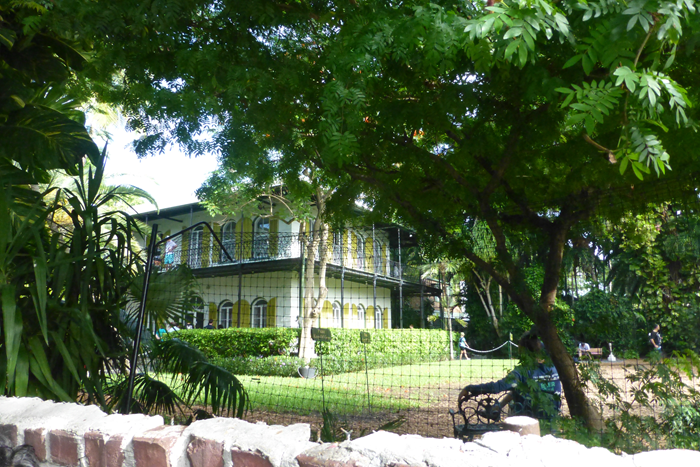
I walked through the entrance, following the Dalton-Bond’s path along the narrow walkway. Well, alright, I walked back and forth a few times, much to the dismay of the Anonymous Gang, to reenact Bond’s entrance while cats (the celebrated polydactyl cats synonymous with the house) scurried away on the grass and into the bushes. A strange feeling took possession of me—no, not the death-like mood I had earlier in the bar but a wistful sentiment as I looked at the garden and the house. Despite the crowd—and there were throngs of Japanese tourists roaming the grounds, snapping photos—I sensed the tranquility of another time and the solitude of a man who lived and wrote some of his best works in this Spanish Colonial house in the 1930’s. There was a lot of sorrow when he lived here. It lingered all these years, now clinging to me, as I walked through the front door. There was also an element of a bygone, antiquated charm throughout the house. The paintings, chandeliers, framed posters of 1930’s movies, and other furnishings—all kept in pristine care over the years--evoked the sense that a certain time period had never passed, preserved in a magical stillness.
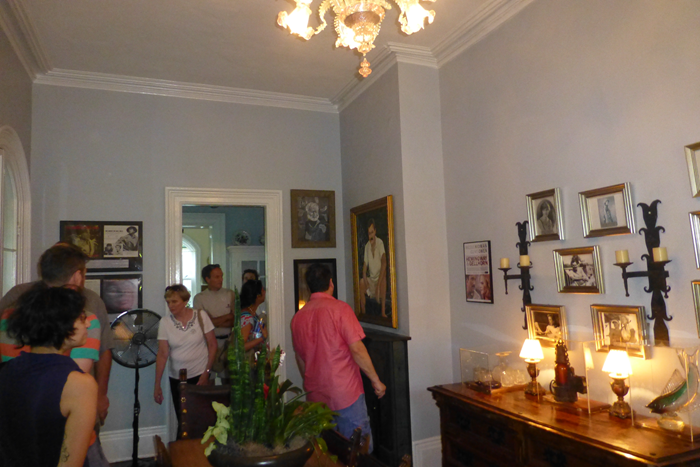
The docent led us from room to room, recounting anecdotes about Hemingway. There was a time when he walked into these rooms. He was long gone but his essence lingered, somehow. A cat napped on a bed, or stood on a corner table, or leaped onto a sofa. Visitors gushed over the antique furnishings: Hemingway was quite the collector of Spanish furniture from the 17th and 18th centuries; and his walnut secretary desk from the 18th century, built with hidden compartments, has become one of the popular displays.
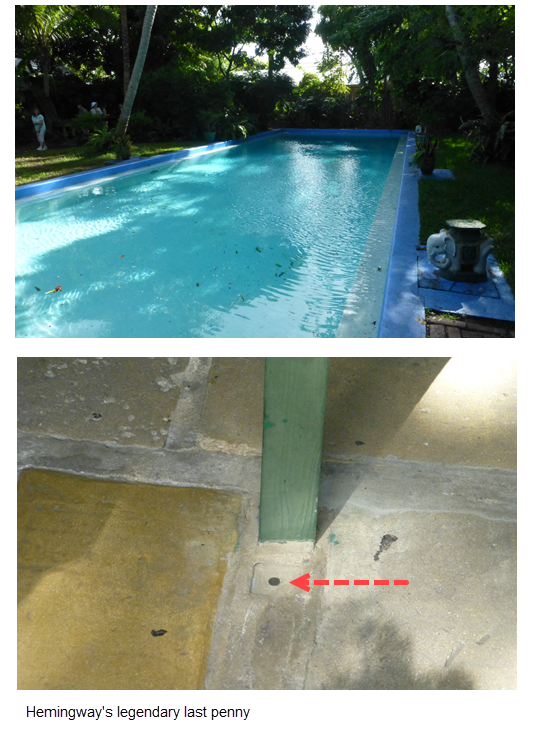
No tour of the Hemingway house is complete without a stop at the swimming pool. For decades, it showcased its own lore: supposedly, Hemingway—outraged by the increasing construction cost of the pool—threw a penny onto the half-built pool patio and bawled, “Pauline [his second wife at the time], you’ve spent all but my last penny, so you might as well have that!” To memorialize his alleged outburst, the keepers of the estate have embedded the purported penny coin into the limestone pavement at the north end of the pool. Of course, the whole notion is highly dubious because, as widely known, the pool had been financed by Pauline’s magnanimous Uncle Gus. So why in hell would Hemingway be so concerned about the construction expenses? Nevertheless, the incident underscores the estate’s intriguing history: at the time, the pool cost an outrageous $20,000 but was the first in-ground pool in Key West and the only pool of its kind within a 100-mile radius. Surprisingly, despite its mythic dimension, the filmmakers of Licence To Kill never took advantage of using the pool in any scene of the Hemingway sequence; for example, it would have been a more interesting backdrop than the bland balcony where M confronts Bond.
At the pool patio, I asked the docent if he witnessed the filming of Licence To Kill on the estate.
“That happened eight years before I came to Key West,” he explained. “But I know the scene.” He sighed, looking up at the balcony. “Sometimes fans will ask if they could try that jump [that is, the Dalton-Bond’s jump over the handrail]. It makes me nervous. It’s hard to tell how serious they are.”
The balcony wrapped around the house to form a quaint veranda. But as I walked along it, recalling how the filmmakers presented it in the film, I realized this entire scene with M is a jumble of different angles and segments of the balcony, pieced together in tight editing:
- Part 1: M, on the balcony, watches Bond walk through the front gate accompanied by MI-6 agents. Thus, we see M in center position on the balcony, looking down at Bond. In other words, he is standing on the balcony that faces the front entrance.
- Part 2: Bond walks up the stairs to the balcony. But I had to chuckle as I noticed that the stairs used for this camera angle does not lead to the part of the balcony where M stands. By my estimate, when we finally see M and Bond together, director John Glen staged their confrontation at the south eastern end of the balcony, which faces the direction of the lighthouse that Bond notices just before he relinquishes his Walther PPK.
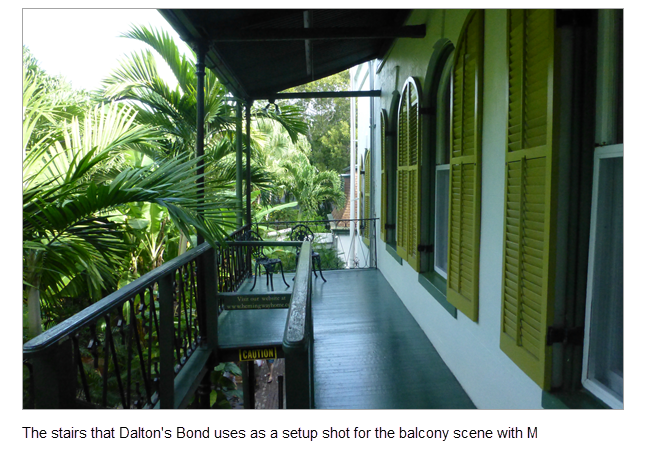
I stood on this south eastern end of the balcony, mimicking M’s stance as he waits for Bond, and looked down at the lawn. It was at least a 15-foot drop, certainly unrealistic for anyone to leap unscathed. In the novelization, both men stand on “that part of the veranda which looked out onto the street—Whitehead Street” (71), which bolsters my suspicion that the scene in the film was staged at the southern portion of the veranda: again, from this view to a kill, one gets a good glimpse of Whitehead Street and the lighthouse. Meanwhile, as described in the novelization, we have Bond walking up the stairs and sensing the pervading gloom that I had also felt earlier:
Very gently the pair of bodyguards—for that is what they were—led Bond up the flight of steps to the veranda. Even on this structure, Bond could feel the sorrow. Someone had been very unhappy here. He hoped he was not about to join in with the sense of despair which permeated the place. (71)
So what is this sorrow that Bond is sensing? In short, it’s the allusion to Hemingway’s unhappiness. By 1932, his second marriage (and he had quite a collection, a total of four) was crumbling and the subsequent years were full of turmoil. Tormented by restlessness, bouts with anxiety from the lukewarm reviews of Death In The Afternoon (his bullfighting opus) and the torrid dalliance with Jane Mason—a 22-year old bi-polar socialite who jumped off a balcony in a botched suicide attempt—Ernie Boy was an existential wreck, aggravated by what he saw in his second wife (namely, a growing irritating presence) and plunged into a volatile mood, grouchy, contentious, snarling about breaking his detractors’ necks, especially the critic Max Eastman, who classified Hemingway’s literary style as “false hair on his chest.”19 To make matters worse, there was Gertrude Stein, who said nasty things about him in her memoirs, which (of course) provoked Hemingway to explode: he retaliated, proclaiming that he had cojones, and that he could always write brilliantly, never having lost the magic; and, damn it all, there would be a new collection of stories to prove it, so to hell with all these swines and two-faced hacks. To prove his virility, he contributed machismo sporting articles to a new magazine for real men—those with authentic chest-hair and brazen cojones—although the rag was unfortunately focused on refinement and urbanity, as signaled by its wimpy title Esquire.20 Yet for Hemingway, it was a case of one-upmanship with the vermin brigade.
All this time, the second marriage limped on. Pauline Pfeiffer (wife number 2) remained loyal and a staunch cheerleader. She managed to give him two sons, adding to the existing one from his first wife, Hadley Richardson. Hemingway longed for a daughter; but there would be time enough (or so he thought), especially when the spectre of wife 3.0, Martha Gellhorn, entered the scene. I must be quick to add that they met in Sloppy Joe’s; and she—a journalist who sported cascading blonde hair—was enough to captivate the adamant he-man. Pauline was fearfully aware and wanted to save the marriage. Sad to say, the struggle in their marriage continued: despite the wretched arguments, she had the pool in the Key West house built to keep him near; but eventually, Hem did the two-timing routine as he ran off to Catalonia for Christmas with would-be wife number 3 and joined her in Madrid, both as foreign correspondents to cover the civil war. Pauline, on the other hand, grew her hair to shoulder length as the last tactic in her arsenal of enticements. Alas, it seems timing was not one of Hemingway’s strong suits: he ran into Pauline in Paris, which led to more quarrels and her threat to jump out of a hotel window (shades of the Jane Mason fiasco—old Hem hand the knack to find this type of woman).
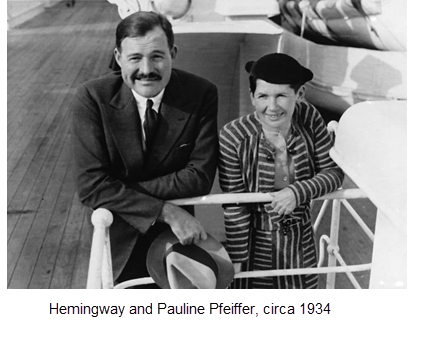
All the while, he struggled with his liver as doctors warned him off the booze, complained that his dispatches from the civil war were cut severely by his editors, and was racked with remorse, convinced that his second marriage had to end. He was usually alone in the Key West house, where he resorted to hard drinking again (an average of fifteen Scotch and sodas each day, as noted by his brother Leicester), and longed to be back in Spain with impending wife number 3. Finally, he found consolation when the third marriage was official on November 21, 1940. In its aftermath, the Key West house fell into the ownership of Pauline. Hemingway’s residence, henceforth until 1960 (one year prior to his suicide), was Finca Vigia in Cuba. It was here where the third marriage was blissful—for about two weeks. Inevitably, they got into each others way. Martha resented being in the shadow of a famous author. He resented her flourishing career. Both wandered into infidelities. Of course, he got drunk often, even longed for another African safari, and complained that Martha was a swashbuckling correspondent who ignored him to cover conflicts in other parts of the world.
As I roamed the balcony and wandered into the rooms, I couldn’t shake the feeling of discontent and darkness in the house. I went back to the room with the walnut secretary desk and imagined Hemingway seated behind it with hand on chin, remembering the time when he was young in Paris and had enough happiness with his first wife and their little son Bumby. A plump ginger tabby cat brushed against my leg. It stared at me, purring, but I remembered the estate’s rule not to pick up any of the cats. In another time, Hemingway would have held a cat in this very room, his only solace in the emptiness. The lavish six-hour mini-series Hemingway (1988), with Stacy Keach in the eponymous role, depicts the man’s solitude in a haunting scene in which he is alone in the house, standing by the pool at sunset, carrying his cat Boise, and muttering, “What am I going to do, Boise? What am I going to do?” The cat staring at me might as well be one of the descendants of Mr. Boise. According to the docent, there were sixty of them roaming the estate, about half of the them polydactyl (having six digits on their forepaws), but all descending from Hemingway’s original cats and, in one sense, quite the attraction, even enlivening the dour atmosphere of the house.21
The one looking up at me, lifting its left paw and offering a silent meow, certainly made me smile—a momentary refuge in the gloomy surroundings. It was the sort of place where novels, brimming with darkness, would be written. I recalled some haunting lines from Hemingway’s A Moveable Feast, which strangely prefigure the aura of the Key West house:
It was a wonderful meal at Michaud’s after we got in, but when we had finished and there was no question of hunger any more the feeling that had been like hunger when we were on the bridge was still there when we caught the bus home. It was there when we came in the room and after we had gone to bed and made love in the dark. . . . I put my face away from the moonlight into the shadow but I could not sleep and lay awake thinking about it. . . . Life had seemed so simple that morning when I had wakened. . . . But Paris was a very old city and we were young and nothing was simple there, not even poverty, nor sudden money, nor the moonlight, nor right and wrong nor the breathing of someone who lay beside you in the moonlight. (37-38)
A Moveable Feast constitutes the Paris memoirs, reflecting Hemingway’s years as a struggling expatriate correspondent with his first wife, Hadley Richardson, in the 1920s and published posthumously in 1964. None of its manuscripts (notebooks, as he called them) were written in Key West. Instead, it was here on the island where he wrote portions of A Farewell To Arms (he arrived with a crumpled pencil manuscript), the short stories “The Snows of Kilimanjaro" and "The Short Happy Life of Francis Macomber," and the novels To Have and Have Not and Green Hills Of Africa. His writing studio was in a detached carriage house adjacent to the main house. His daily routine: write from 6 a.m. until noon, averaging 500 to 700 words per day. He produced seventy percent of all his works in the nine years he lived in this house. A catwalk (no longer in service) connected the second floor balcony of the house to the studio. For me, a glimpse of this room was the centerpiece of the tour. For it was Hemingway, along with Fleming, who inspired me to pursue some kind of writing career.
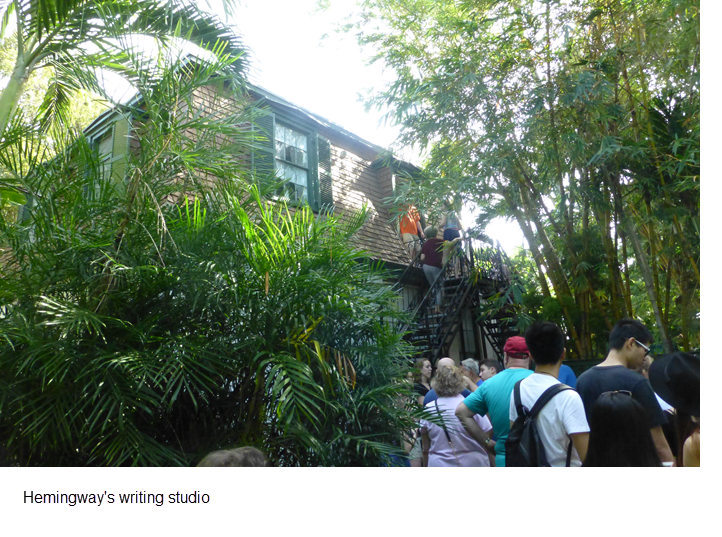
A steep staircase led to the studio, where one can stand on a narrow porch of the gated doorway. With a stream of tourists on the stairs, it was something of a wait to have a look. There was enough room for one person on that porch, although the two Japanese girls standing before me, giggling, were able to stand next to one another. But, at last, I stood at the gate: there I was peering into the room where this great author sat and thought and brought to life prose from the clatter of his typewriter. The studio, uncluttered with a red-tiled floor, was somewhat spacious (by my estimate, roughly 20 feet long and wide), with windows that overlooked the swimming pool and garden. Big game and deep-sea fishing trophies adorned the walls. Hemingway’s original typewriter, his leather writing chair, and a collection of treasured books have been preserved as he left them. According to the docent, 80% of the artifacts belonged to the writer. There were bookshelves and a chaise lounge, and, supposedly, the stool that Hemingway preferred to sit on while drinking at Sloppy Joe’s.
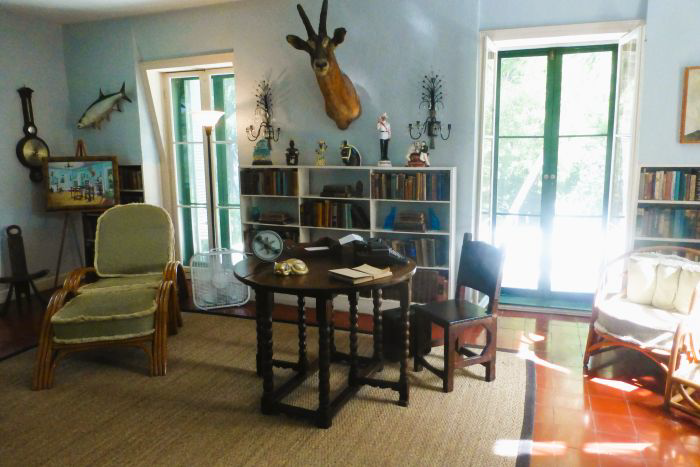
The typewriter was on a wooden desk where a calico cat perched and licked its paws. I stared at the typewriter for a long while: it was the purported typewriter that Hemingway used when he was following General Patton during the second World War. I imagined Hem’s thick fingers tapping on the keys and slamming back the carriage release, his eyes focused on the manuscript, as he attempts to grasp the words flowing in his head. “All you have to do is write one true sentence” (12 A Moveable Feast), he must have reminded himself, the mantra that formed the basis of the so-called Hemingway technique, its beginnings formulated during the Paris years and perfected by the time he was here, in this writing den. Prose without frills, without the imposition of the author’s viewpoint. A cleansing of language that accords with the movement of that period, breaking from the traditions of the past, as sought by the Lost Generation as they struggled to grasp a post-war world. Thus, the Hemingway prose was quite the innovation, trendy enough to be praised by the nouveau literati expatriates in Parisian cafes. We find it, early on, highlighted as sketches (brief chapter introductions) in the short story collection In Our Time (1925). Take, for example, the sketch for Chapter Two:
Minarets stuck up in the rain out of Adrianople across the mud flats. The carts were jammed for thirty miles along the Karagatch road. Water buffalo and cattle were hauling carts through the mud. There was no end and no beginning. Just carts loaded with everything they owned. The old men and women, soaked through, walked along keeping the cattle moving. . . . Carts were jammed solid on the bridge with camels bobbing along through them. Greek cavalry herded along the procession. The women and children were in the carts, crouched with mattresses, mirrors, sewing machines, bundles. There was a woman having a baby with a young girl holding a blanket over her and crying. Scared sick looking at it. It rained all through the evacuation. (21)
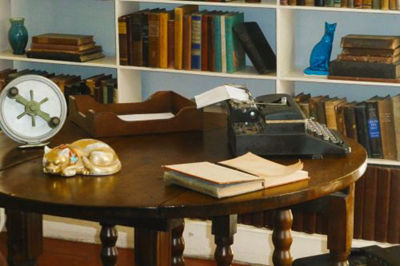
The sketch takes us to the center of the Hemingway technique: unembellished prose, with a dry “unliterary” tone venturing into reportage, even dispassionate, a subdued voice refraining from judging, from commenting, to efface blatant authorial intrusion. It was new music to the ears of the highfalutin literary critics; but for the masses, it did not resonate, at least not yet. At this stage, his great novels and short stories were still to be written. Certainly, at first glance, little remarkable sticks out from the technique; but it’s all rather easy to emulate nowadays, primarily because Old Hem has acclimatized us to it: we take for granted the bareness of the prose and its associated iceberg theory, wherein the crux of the story lies below the surface, because Hemingway has led the way, showing us how to do it. Yet it wasn’t easy at a time when the literary world was still bound to the Victorian and, by extension, Edwardian sentiments, showcasing ornate veneers that had passed for aesthetic excellence, along with the overt personality of an omniscient narrator presenting itself to the reader. Consider the prose of E.M. Forster in his magnum opus A Passage To India (1924):
On the second rise is laid out the little civil station, and viewed hence Chandrapore appears to be a totally different place. It is a city of gardens. It is no city, but a forest sparsely scattered with huts. It is a tropical pleasaunce washed by a noble river. The toddy palms and neem trees and mangoes and pepul that were hidden behind the bazaars now become visible and in their turn hide the bazaars. They rise from the gardens where ancient tanks nourish them, they burst out of stifling purlieus and unconsidered temples. Seeking light and air, and endowed with more strength than man or his works, they soar above the lower deposit to greet one another with branches and beckoning leaves, and to build a city for the birds. (8)
Such prose is more “illustrative” than a vivid, realistic account: a sort of prose-like painting evoking an almost magical landscape while cloaked in omniscient narration. The tone is a prissy one, delicate, genteel, compatible with the lofty narration that relies heavily on personification, a mechanism for signaling the deep mysteries of India that will only be explicated as the novel unfolds. We are not only introduced to any river but to a “noble river” that washes the “tropical pleasaunce” of Chandrapore (a fictional city). The trees seek light and air and their branches greet one another “to build a city for the birds.” These are not concrete facts but dramatic expressions of a loquacious narrator.
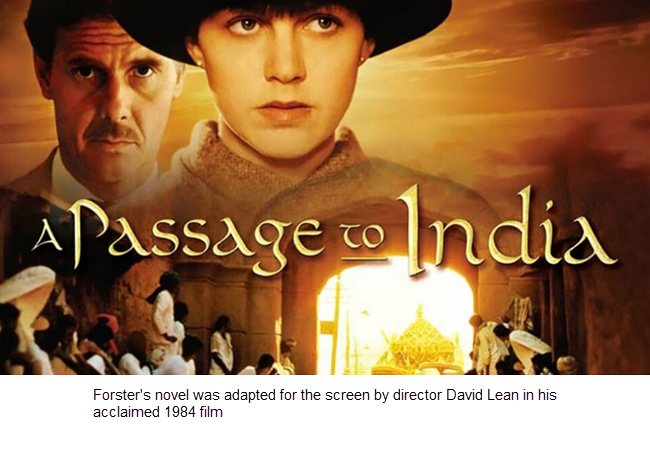
One can see that Forster, still grounded in Edwardian elegance, was hardly a modernist in his prose, although he was a member of an emboldened “hip” faction—the so-called Bloomsbury Group, a coterie of "intellectuals" (that is, a motley crew of Fabian socialists and anti-capitalists) who, in the early twentieth century, managed to convince themselves they could dictate the course of modern culture. Forster’s cronies were Lytton Strachey, Virginia Wolf, Roger Fry, Bertrand Russell, and John Maynard Keynes, to name a few. Moreover, by the time Hemingway was in Paris, Forster still had the glow of a literary titan. But he was, to be blunt, in a fading spotlight.22 From here on, the modernist movement in prose would take center stage. Hemingway’s concoction would even be enhanced to include its own poetic subtleties. The cadence in the opening paragraph of “In Another Country,” one of Hemingway’s finest short stories, cannot be overlooked:
In the fall the war was always there, but we did not go to it any more. It was cold in the fall in Milan and the dark came very early. Then the electric lights came on, and it was pleasant along the streets looking in the windows. There was much game hanging outside the shops, and the snow powdered in the fur of the foxes and the wind blew their tails. The deer hung stiff and heavy and empty, and small birds blew in the wind and the wind turned their feathers. It was a cold fall and the wind came down from the mountains. (267)
Once again, the concise understated prose; only this time, reinforced by the cadence flowing from the frequent use of the conjunction and and the repeated imagery of a dark autumn with cold wind and the stiff carcass of game hanging outside the shops—somehow, it all converges smoothly to evoke an atmosphere of death, which ends with the haunting tone that it was “a cold fall and the wind came down from the mountains.” The approach has shades of the King James Bible, echoing its rhythmic patterns to convey a sort of epic feel (verses from Ecclesiastes come to mind, especially 3:1-8, “A Time for Everything”). In Hemingway’s retooling of his prose, he brought to light poetic elements, subtle but compelling, worthy enough for scrutiny and praise by the literati. Jon dos Passos, in a succinct description, called Hemingway’s style a combination of "cablese and the King James Bible" (Fraser).
From Hemingway to 007
To the aficionado of the 007 books, this business about the Hemingway prose was quite an inspiration for Fleming. The various anecdotes on Fleming sketch his admiration for the American author. An often cited incident, as related to the film From Russia With Love, depicts Fleming’s encounter with the renowned actor Pedro Armendariz, who plays Kerim Bay, Bond’s trusted ally. Armendariz had been diagnosed with terminal cancer during the making of the film, and during a tribute party that director Terrence Young hosted, Fleming and Armendariz “spent much of the time on a couch in Young’s living room discussing Armendariz’s good friend, the late Ernest Hemingway, who committed suicide rather than submit to a lengthy terminal illness” (Rubin 33).23
Casino Royale, the first 007 novel, has something of a connection to Hemingway lore. A year before its publication, Fleming’s only son, Caspar, was born on August 12, 1952.24 According to the Fleming biography by Andrew Lycett, the birth proved difficult for Ann Fleming, and doctors detained her for two weeks. During her recovery, Fleming left a copy of Hemingway’s latest novel, The Old Man and the Sea, in her room (230). This prefigures Lycett’s account, later in the tome, that Fleming—at one point, the foreign manager of the Sunday Times—requested fellow Jonathan Cape author Norman Lewis to interview Hemingway in Cuba and file a report. As the story goes, Fleming believed that Hemingway, “a writer he idolized, was in touch with the rebels and really knew what was happening.” Yet, despite proceedings from Jonathan Cape, “who was Hemingway’s British publisher and friend, the assignment failed to reveal anything new” (320-321). Still, the influence of the American author on Fleming cannot be underestimated. As the latter brooded over the “spy story to end all spy stories” (as he called what eventually would become Casino Royale), Hemingway had already garnered widespread fame, reaching the stature of the twentieth century's most influential writer. The burly author was no longer the struggling expatriate in Paris; he was Mr. Celebrity Author. Inevitably, Hollywood jumped on the bandwagon, churning out film versions of his novels. Even his mug, like those of Picasso and Einstein, was recognized by millions, many of whom, we can be virtually certain, have never read a word he wrote. Yet the admiration from Fleming juts out in the first 007 novel: in the opening paragraph, just before James Bond is introduced to the world for the first time, we encounter Fleming attempting the Hemingway style, inserting touches of cadence by way of conjunctions, and asserting a singular atmosphere through repetitive imagery associated with gambling (emphasis from me):
The scent and smoke and sweat of a casino are nauseating at three in the morning. Then the soul-erosion produced by high gambling—a compost of greed and fear and nervous tension—becomes unbearable, and the senses awake and revolt from it. (1)
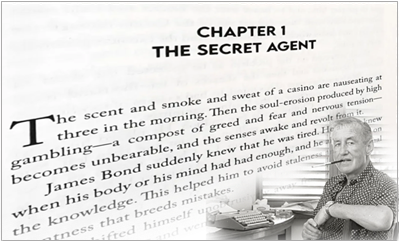
The concise unadorned passage no doubt stems from Fleming's journalistic background but is also reminiscent of Hemingway's minimalism. Fleming depicts an arid, smoke-filled casino, encased in the state of high gambling—a region sealed in an airless, confined space to suggest an existential entrapment, if you will. Within are the human passions of “greed and fear and nervous tension” that erode the soul. Here, then, is the basis of the terrors in the world: passions that grind down one’s humanity, passions that induce nefarious schemes, foreshadowing the psychological state--though magnified more intensely—within your garden-variety megalomaniac Bond villain. We’ve entered the world of 007, haunted by irrational forces, dark and threatening, and full of avarice and deceit. A healing element, though, surfaces: those still in touch with basic humanity have at least some fortitude to shun, or awake and revolt from, these darker impulses.
The Hemingway influence is sporadic in the novel. Here it is again, near the ending, showing flashes of the Hemingway cadence, unfolding by way of conjunctions, and the focus on a single atmosphere—a gloomy one, evoking death and solitude (emphasis from me):
He reached up and held [Vesper’s hand], and they stayed motionless for a moment. She bent down and lightly brushed his hair with her lips. Then she was gone, and a few seconds later the light came on in her room. . . . It was only half-past nine when he stepped into her room from the bathroom and closed the door behind him.
The moonlight shon through the half-closed shutters and lapped at the secret shadows in the snow of her body on the broad bed. (162)
One could argue that what Fleming churned out here, especially with descriptions in the last line (“secret shadows in the snow of her body”), is a tad over-the-top. But the damn thing somehow works in a melodramatic but macabre way. A sense of unity abounds with the imagery, a ghastly one, full of darkness and death: as Vesper lies in bed, “the shadows in the snow of her body” echoes Bond’s death-like image of having “a taciturn mask, ironical, brutal, and cold” (7) when he falls asleep in his hotel room at the end of the first chapter. And this imagery of a sleeping Vesper also foreshadows the somber finale when Bond discovers her in bed, “straight and moulded like a stone effigy on a tomb” (174). Hence, Fleming is able to drop this unified atmosphere into his prose, only because Hemingway had pioneered this approach.
The homage to Hemingway continues in the short story “The Hildebrand Rarity.” Bond meets a wealthy American, Milton Krest (the villain of the piece) and thinks, “This man likes to be thought a Hemingway hero. I’m not going to get on with him.” The meeting takes place on the Wavekrest, the American’s yacht (which is moored in the Seychelles); and his rugged appearance—“a tough leathery man in his early fifties” clad in a pseudo military attire—is bolstered by a Bogart-like voice, soft, “lisping through the teeth”(149). To Bond, the man’s style, the manner in which he projects himself onto the world, is a blatant emulation of the Hemingway hero. Moreover, Bond’s thoughts reveal quite a bit of character: we gather Bond has read enough Hemingway material, even some of the book reviews, to understand the concept of the so-called Hemingway hero. In addition, Bond’s presumption that he wouldn’t get along with Krest suggests his admiration for what constitutes a hero in Hemingway fiction. Put another way, his disdain for Krest is not a condemnation of Hemingway's creation; instead, it has to do with Krest’s braggadocio personality and his misuse of the Hemingway hero as a mask to flaunt himself as something that he is not—which, for Bond, is a mockery of what the American author had formulated into a new type of individual. What’s so remarkable about this character anyway?
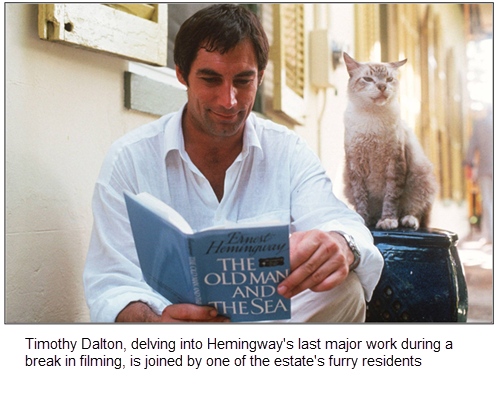
Well, so far, he hasn’t been canceled by today’s conventions.25 We’ve touched upon this individual in the discussion about the chap in the tent in the Kilimanjaro tale, who faces his own death. The gist is that one needs to remain calm, even stoic and brave in the face of darkness, death, and, alas, the sheer futility of existing as a puny thing in an indifferent universe. So this person adheres to a code of conduct: once again, the phrase “grace under pressure,” coined by Hemingway, is the key to understanding this character. Better to confront one’s impermanence bravely, the gateway to becoming a dignified individual, though one must repeat the method continuously, to maintain the stature, while knowing it all ends ultimately in mortality itself. This takes us back to the carpe diem drill, mixed of course with dry existentialism: Hemingway heroes are individualists with a propensity for free will and who understand there is nothing beyond oneself to provide any meaning or purpose. Sloshed in bacchanalian joy, they embrace life to the fullest, moving from one love affair to another and delving into any scenario—be it wild game hunting, or entering a battlefield, for example—where one can show courage and endurance in the face of death. In other words, these individuals, seeking in large part the gratification of sensual pleasures, live with a strong awareness for having only one life, precarious, contingent, threatened by the inevitable. Thus, a Hemingway story typically has a downbeat ending. Jake Barns, Robert Jordan, Santiago, to name a few, all face some form of loss or demise; but their struggle, handled with bravery in the presence of death, gives them a deeper experience of being alive.
Of course, all this bravura, carousing, and drinking are best handled at night. After all, for the Hemingway hero, sleep is a deathlike state, a sort of obliteration of consciousness. Night itself becomes the disturbing symbol of the utter darkness that comes with death. Best to negate it, deny it of presence, by staying awake and delving into the very act of living. In “A Clean, Well-Lighted Place,” an old man in a café sits in "the shadow the leaves of the tree made against the electric light" (379). It's almost 3 a.m. but the café, with its lights, is the only refuge in his harrowing solitude and existential darkness.
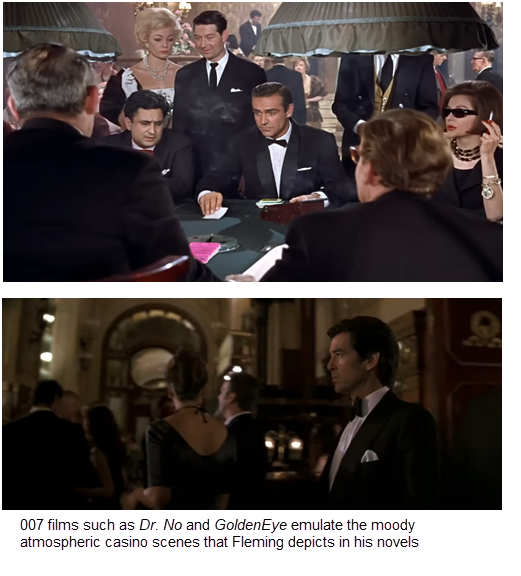
Fleming’s Bond has shades of these traits. In Casino Royale, we find him restless, still awake at 3 a.m. and roaming the casino floor. It gives us the impression that he’s avoiding the state of sleep: he returns to his hotel room and, despite his tiredness, he doesn’t go to bed. Rather, he smokes “his seventieth cigarette of the day and sat down at the writing table with the thick wad of his stake money and winnings beside him and entered some figures in a small notebook” (7). Much of the action in the novel, for that matter, occurs at night, suitable for the bustling casino life, which Bond (a devout gambler) savors. He even becomes introspective at night, grappling with his thoughts on Vesper Lynd, the heroine of the piece. Near the end of the novel, he is alone on the beach, sitting against the backdrop of the vast ocean, the infinite expanse of the night sky, facing questions about the enigmatic Vesper who, for Bond, becomes something of a beacon in all that empty darkness: it’s here, in the dark, where he comes to realize she is the one for him, a person “thoughtful and full of consideration without being slavish and without compromising her arrogant spirit” (157). And it’s here, during nightfall, where he also considers resigning from the service and traveling “to different parts of the world as he had always wanted” (157). Once again, the attempt at embracing life (yes, the old carpe diem routine) before it all ends in death.
Of course, none of these options come into play: as fans of the 007 books would know, Fleming throws in a doomed outcome for the couple. The bits of light in Bond’s emotional darkness are suddenly extinguished, although one could say he should have known better, the obvious giveaway signaled by the woman’s name, Vesper, which is Latin for “evening.” She is, in that sense, night incarnate. But Bond, in something of the spirit of the Hemingway hero, pulls himself together and finds the inner strength to confront adversity: alone in the hotel room with death, now in the shape of his inamorata lying in bed “like a stone effigy on a tomb” (174), Bond vows to fight SMERSH (the Soviet terror apparatus) and to hunt down the “threat behind the spies, the threat that made them spy” (179). He has reformulated himself, so to speak, and finds something as a foundation to his life, something to act upon and make life worthwhile, to struggle for a cause. Subsequent novels also reveal his bravery that remind us of the Hemingway hero’s fierce dignity in the face of death. In Moonraker, for example, when Bond is trapped with policewoman Gala Brand in a room near a rocket launching pad, he uses his teeth to light a blow torch and uses it to free the woman.
These bits of Fleming/Hemingway parallels are enough to underscore the American author’s influence on the creator of James Bond. It was even apparent to the literati who mingled with Fleming. Norman Lewis, as asserted in Nicholas Shakespeare's Ian Fleming: The Complete Man, had said that Fleming was a "'fanatical admirer'" of Hemingway to such an extent that "'he had read all [of Hemingway's] books several times, and believed he had come to absorb Hemingway's distinctive style in such a way that he frequently wrote passages agreed among his friends to be indistinguishable from the work of the master.'" Apparently, the emulation was so keen that another of Fleming's cohorts, the critic and novelist Cyril Connolly, called it “Flemingway” (175). Yet by no means did Fleming lack his own voice. With the debut of Casino Royale, the remarkable style of a new thriller writer emerged, and the voice we encounter tells the story with conviction while ushering us along at a breakneck pace, an “underrated feat anyway,” according to Kingsley Amis (130). And through it all, we have Fleming’s unique take on people, places, and things. The semblance to Hemingway’s iceberg theory is unavoidable, at least in spirit: lift the veneer of the mass market escapist fair and one finds something worthy of scrutiny. The approach thrust Fleming’s first novel onto the literary stage not as a one-off but as the prelude to additional James Bond adventures, a unique series of engaging, hard-edged, and atmospheric pieces of fiction.
The carnival of impermanence
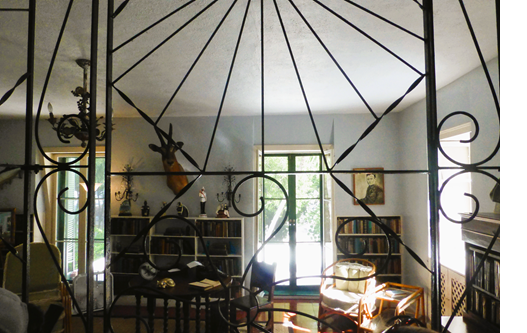
I was still peering into Hemingway’s writing studio, trapped in my thoughts as I stared at the typewriter through the Spanish-style wrought-iron bars that blocked the doorway. Unaware of anyone else waiting to look, my mind was a maelstrom of Hemingway prose, passages from Fleming, death itself (inspired by the dead animals on the walls of the room), and the mythology that surrounded the American author.
Sternly, the Japanese tourist standing behind me cleared her throat.
Emulating George Lazenby’s line in On Her Majesty’s Secret Service, I managed to mutter, “Forgive me. My mind was elsewhere,”and walked down the stairs.26 But I could not shake off the emptiness that I suddenly felt. It was the same emptiness that engulfed the room with the walnut secretary desk and the ginger tabby cat. I walked along the pathway, through the throng of visitors, and reached the garden but the emptiness was there. I noticed my niece and the Anonymous Gang. She was motionless in the milling crowd, her windbreaker dark red, almost black, but she was smiling, suspended in a sort of eternal stillness, like the captured moment in a photograph, though it faded quickly when she waved to me, thrusting herself back into impermanence. Together, we strolled to the cat cemetery, a tranquil spot where the four-legged residents were laid to rest, memorialized with their name, birth and death years on gravestones.
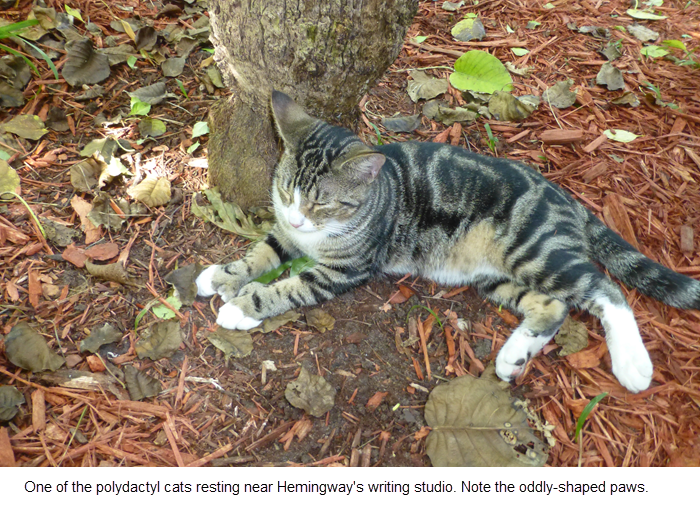
It was a moment of serenity in complete contrast to the noise in the gift shop. The bustle of people browsing the merchandise reinforced the commercialism I had noticed earlier in Sloppy Joe’s. In a sense, I had walked into a vault containing Hemingway keepsakes and novelty items—coffee mugs, postcards, framed prints of the house and pictures of the cats, and of course shelves loaded with Hemingway books and biographies. Not that the original homeowner would have objected: in his time, he was aware of his rising celebrity “branding” in Key West and alluded to it in a satirical piece for Esquire in April 1935:27
The house at present occupied by your correspondent is listed as number eighteen in a compilation of the forty-eight things for a tourist to see in Key West. . . . To discourage visitors while he is at work your correspondent has hired [an attendant] who meets visitors at the gate. (Remnick)
Today, the house has moved up to the top of the charts, becoming the most significant address on the island.
I couldn’t leave the place without looking at the writing studio again.
“The others are waiting,” my niece said, reminding me of the impatience of the Anonymous Gang.
But the porch of the writing studio was suddenly empty and I climbed up the stairs, looked into the room one last time, and was haunted by a sense of finality. Hemingway was long gone. He will never return to this room. His works are preserved but, in one sense, fading into forgetting. If things were to recur eternally, as Nietzsche expounded in the notion of eternal return, then Hemingway and his works would stand out permanently, his uniqueness always exposed. But because we have someone who will not return, his works have turned into mere words, theories, even denunciation in some academic circles, a convergence into a drone of blather, insubstantial and evanescent, and eclipsed by the forces of commercialism. Alone on the porch, I took a moment to remember Hemingway and looked into the distance, towards Jamaica, and thought about Fleming. The association between the American author and Fleming struck me again. Hemingway was born on July 21, 1899. Almost 100 years later, Licence To Kill, an offshoot of Fleming’s fiction, was released in the US on July 14, 1989, just days before Hemingway’s birthday.
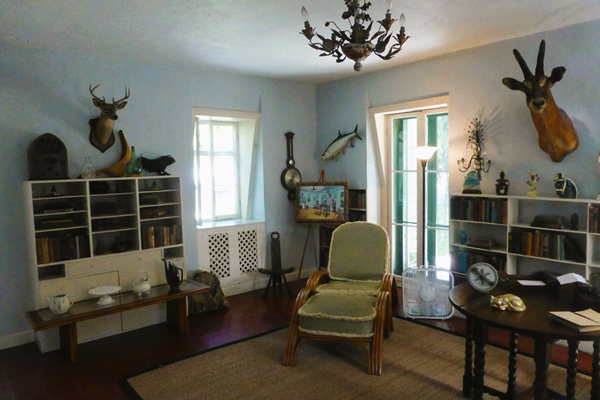
From below, my niece was calling me. I glanced at the garden path and the house itself. Suddenly, I felt like an intruder who had entered the grounds to peek into someone’s home. I tried to formulate a permanent image in my mind of the writing studio as I walked down the stairs. If there were spirits here, have they yearned for any privacy and serenity? As I walked past the ticket booth into the street with my niece, I realized what a privilege it had been to roam the place. I closed the gate, feeling that I was also leaving behind fragments of time when a man wrote great fiction here and when filmmakers and actors shot scenes for a Bond movie.
I looked at Whitehead Street, taking in the bustle of the area. Today's Key West was a worlds away from the one Hemingway knew. The trolleys and trams for sight-seeing gave the island the feeling of an amusement park.28 Across the street, two men holding hands walked along the sidewalk. The line for the Hemingway house stretched an entire block. A woman with a nose ring and green hair handed out flyers for a gay disco on Duval Street. In a distant era, the venue was the Monroe County Movie Theater where To Have and Have Not and The Old Man and the Sea were screened. The crowd waiting to enter the Hemingway house would eventually trot over to Mallory square—the famed waterfront plaza blaring with local musicians, street magicians, and souvenir peddlers—to watch the Key West sunset.
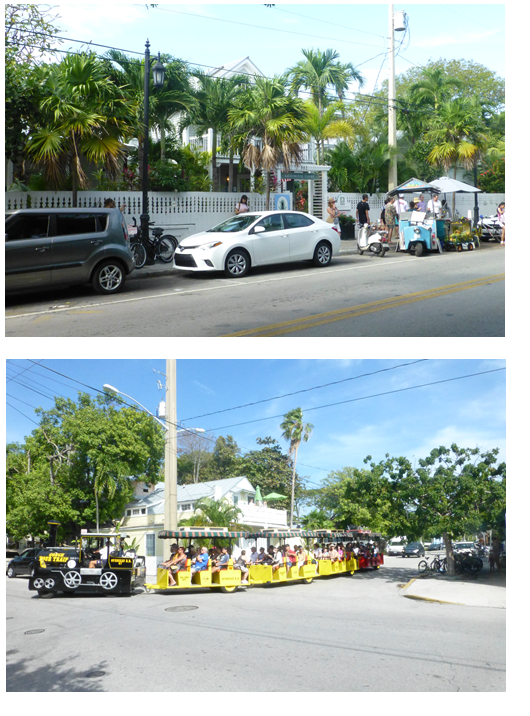
There were more pubs and restaurants and inns on the island than there were in Hemingway's time. Yet the shadow of the past somehow lingered. Not far way, Sloppy Joe’s resounded with the clinks of glasses, echoing the spirited moments that Hemingway shared with the locals. Boats were everywhere, a constant reminder of Hemingway’s fondness for big game fishing. It was easy to imagine his own 38-foot vessel, Pilar, returning to the pier with slayed marlins. The sun would soon set, just as it had done when he was on the island, a blazing orb descending slowly into the shimmering ocean.
On the sidewalk, I turned away from Whitehead Street and its clamor and faced the house one last time. It felt like I was also looking at Goldeneye, looking at the spirit of Fleming’s world. This one of many nondescript intruders, and far from being the last or anywhere near the last, had stepped into the realm of legends; but I could at least give back a piece of privacy to these shadows as I offered a silent goodbye—my own farewell to kings. There, beyond the gate, the shadows of legends can have a touch of serenity and solitude again.
Notes
[1] It was amusing to see Bond history through the warm innocence of a child. At that time, having endured my babbling lectures on Goldfinger back at the Fountainbleu Hotel, Kristen's understanding of Bond villainy centered on the one and only Auric Goldfinger.
[2] For a rundown on Fleming's approach to Live and Let Die, refer to my article "Live And Let Die: Terrors from the Caribbean Gothic."
[3] The Milton Krest character hardly resembles the one depicted by Fleming. Played by Anthony Zerbe (a skilled if underrated actor), this version of Krest shares the boozy flair of the literary version but comes across as more of a yes man for Sanchez, not the wealthy braggart in the Fleming tale who commands his own way in the world. The film version also undergoes a different demise than the one in the short story: in an outrageous scene, Sanchez’s bodyguards throw Krest into a decompression chamber, where he hyperinflates until he explodes.
[4] Long story, not worth it.
[5] It became a six-year hiatus. The box office weakness of Licence To Kill was one factor of this demise. But those empty years were fueled in large part by the protracted legal mess involving the Bond producers and the studio, MGM/Pathe.
[6] This is the 2005 version of the watch—a splurge on my part for a bit of brightness during the disturbing period when negotiations between Brosnan and the producers began to falter for a proposed fifth film in his tenure.
[7] Kierkegaard: An Introduction by C. Stephen Evans provides a readable synopsis of the Danish philosopher’s ideas.
[8] I recall a classmate in college, a young woman, ambitious (or restless, one could say) in her pursuit of something. She wrote papers on the Chinese occupation of Tibet, downloaded protest photos of Buddhist monks from the web and would stare at them and dream of freedom. From college onwards, she looked for people in groups, clubs, political affiliations, to hold hands with in solidarity. Not to denigrate her efforts—somewhere within her is some kind of concern for the world—but her quest does have an unsettling angle that accords with Kierkegaard’s notion to fill the void of boredom. She first encountered the magical solidarity in Scientology (her parents were devout members), then in the Atheist Alliance International, then she found it, or so she thought, in the academic circles of Marxist literary theory, followed by her embrace of the structuralist theorists, the climate change fanatics, the anti-abortion crusaders (protect the sanctity of fetal life!), only to switch to the pro-abortion movement (a woman owns her body!). In recent years, she sought solidarity among advocates of vaccination mandates and covid restrictions; in the community organizing efforts of Planned Parenthood; in the post-modernists, in the anti-colonialists, in the supporters of the Capitol Hill Occupied Protest (CHOP), in those with neurotic disdain for all things Trump, even losing herself in the fanatical belief in the Russia collusion hoax, as well as losing herself in pro-Palestinian activism (Globalize the Intifada!). But she eventually found comfort in teaching elementary school kids. Here at least she could always rely on solidarity with her students, instilling in them her ideals and to say exactly what she believed, and together they comprise a joyful single entity that fills any emptiness that haunts her.
[9] The origin of this line is unclear. The de facto stance is that it has a classical Greek antecedent, typically attributed to Euripedes. It does appear in Sophocles’s Antigone and reused by other writers over the centuries. I’ve seen it in Boswell’s Life of Johnson, as well as in Longfellow’s mythological poem “The Masque of Pandora.”
[10] In Either/Or Volume 1, Kierkegaard’s meditation on boredom includes a summary of its origin, in the section “The Rotation Method,” which depicts a world besotted by boredom. Presented as a satirical parable, it asserts that God created man from having nothing else to do. The seed of human existence, then, is boredom. Adam, however, was alone and bored. Inevitably, he asked for Eve. Adam and Eve were bored together and they brought children into the world, but they were bored en famille. Eventually, people multiplied and reproduced, only to be bored en masse. Boredom, like a giant glob of energy, took over the world. Therefore, people created the Tower of Babel, which is an endeavor as boring as the tower is high. Yes, sheer boredom lies at the core of the tower’s creation. Above all, it points to the only reason why people create any culture at all—because the world is boring. The world is full of nothing. Hence, we fill this hollowness with trivialities like human culture.
[11] It certainly helps to hobnob with the Catholic church and the Medicis: although he was guilty of the murder, Cellini was absolved by Pope Paul III. He also managed to find steady work, creating glorious examples of Renaissance sculptors and goldsmithing work for the Medici clan. Britannica has a good rundown on his life.
[12] This villain-manifesto-speech serves as a prelude to what would be a grisly torture scene where Bond is strapped to a stone pedestal-seat that has an active geyser beneath it.
[13] Reports indicate that the gun blast shattered Hemingway’s entire cranial vault. It’s uncertain whether he placed the double barrels of the shot gun in his mouth or pointed them to his skull.
[14] Current photographs of Leiter’s house are available online, most notably at 007 Travelers.
[15] It had been 16 years since Hedison’s first appearance as Felix Leiter in Live and Let Die. We must admit the agent, as seen in Licence To Kill, is too creaky to handle the rapid fire action. His appearance in the pre-titles, very cringe-worthy as he raids Sanchez’s Learjet in an airfield with DEA agents, clearly shows an elderly man struggling to run. If the casting is meant to reinforce the strong camaraderie of Bond and Leiter by bringing back a familiar face to the role, then it’s a serious miscalculation by the filmmakers. The 16-year span is too long for audiences to remember Hedison’s part in Live And Let Die and he’s now too old to be the Dalton-Bond’s contemporary. The filmmakers should have brought back John Terry, despite having a meager presence as Leiter in The Living Daylights. Better to maintain that continuity in the timeline of the Dalton series; and, moreover, John Terry’s Felix Leiter is at least a young and svelte agent, suitable as a present-day friend and ally of Dalton’s Bond. As for Priscilla Barnes, her character comes across as a jet setter/party animal and not a woman with enough maturity to settle down with Hedison’s aging DEA agent.
[16] Despite Gardner’s disenchantment with writing novelizations, he eventually tackled the one for GoldenEye, six years later in 1995. What tortuous reasons coerced him to give it one more whirl, I cannot fathom. But by the mid-1990’s, he contended with esophageal cancer and, as reports indicate, the consequent treatments plunged him into near bankruptcy. It’s not inconceivable that such grim circumstances impelled him to accept the undertaking of another novelization.
[17] In early drafts, Richard Maibaum had titled the film Licence Revoked. It was “a nice, literary title,” he proclaims in the Starlog YearBook of 1989; but the marketing brass scrapped the title, convinced that the public wouldn’t understand the meaning of “revoked.” But for Maibaum, this notion of a license to kill deserves scrutiny: “it has “prevailed all these years” and has “a special significance that it really didn’t have when we started,” he explains. “Killing is out just the way that alley-catting around is out, and you must be more circumspect. Yet if Bond’s license to kill has ever been justified, it’s this time, but he’s forbidden by M to exercise it. That’s an interesting idea” (Gross).
[18] The Hemingway house is designated a National Historic Landmark. Now under private ownership, the property was auctioned off after the death of Pauline Pfeiffer (1895 - 1951)—her wealthy uncle purchased the property as a wedding gift to the couple—and converted into a private museum in 1964.
[19] The phrase was from a scathing essay “Bull In the Afternoon,” wherein Eastman insulted Hemingway by describing the author’s prose as a literary style of “wearing false hair on the chest.” According to the anecdote, Hemingway confronted the critic, bared his chest, and mocked Eastman’s hairlessness. Supposedly, the genteel encounter ended with Hemingway knocking Eastman in the face with a book containing the snarky comment.
[20] Esquire, an American magazine, was founded in 1933 by editor Arnold Gingrich, along with publisher David A. Smart and businessman and journalist Henry L. Jackson. As noted in Britannica, it began as “an oversized magazine for men that featured a slick, sophisticated style and drawings of scantily clad young women.” Eventually, the publishers "abandoned this titillating role but continued to cultivate the image of affluence and refined taste.” Hemingway's articles and some fiction (including "The Snows of Kilimanjaro") appeared in 28 of the first 33 issues of the magazine.
[21] According to Hemingway lore, the author named his cats after famous people, and the tradition continues today. Hence, in the Key West house, one is likely to meet cats named Clark Gable, Bogie, Gary Cooper, Ingrid Bergman, and Lauren Bacall, to name a few.
[22] With his enduring achievement, Forster’s works are canonical in British literature. And, of course, the man is venerated in the academic world. His novels A Room With A View and Howard's End have also translated into decent film adaptions. But his greatest novel, A Passage To India, received the best treatment in what turned out to be David Lean’s last film.
[23] In a ghastly twist, Armendariz committed suicide a month later, shooting himself with a pistol in a Los Angeles hospital. Fleming, in declining health, would not last much longer.
[24] In another ghastly twist, Fleming would die on August 12, 1964.
[25] On could argue that the political Left has been eager to downplay Hemingway’s fiction, even erasing it into a state of forgetting. We need only take note of an article from the leftwing rag The Daily Beast, titled “Why the Hell Are We Still Reading Ernest Hemingway?”, which scorns the man’s novels and offers faint praise for his short stories. The momentum for his cancellation is only heightened by the mandate from Penguin Random House: the top brass of the publishing powerhouse has slapped a trigger warning in its Hemingway publications, pointing out "concerns about his 'language' and 'attitudes'" and the great need to be "alerted to the novelist's 'cultural representations.'" Hence, in our glorious Renaissance-like age, it's only fitting to steer readers away from an author who isn't a person of color, didn’t ask for pronouns, and never suffered the emotional distress from white patriarchal oppression.
[26] The complete dialogue from Lazenby occurs in the casino scene: “Forgive me, my mind was elsewhere. Madame has forgotten we agreed to be partners this evening.” He then throws chips on the chemin de fer table to pay off her debt. In this scene, the countess Tracy di Vincenzo had declared "Banco," which indicates she will bet the limit established by the banker. She loses, however, to the banker and cannot honor the losing bet. But Bond, who has witnessed the fiasco as he sits across the green baize, comes to the rescue and pays the losing wager for her.
[27] The article, titled "The Sights of Whitehead Street: A Key West Letter," is a curiosity, making us wonder if its author was drunk or just in his usual blowhard zeal—or both. Despite the satirical self-mockery, the article is essentially an exercise in self-promotion, written in such a bigoted and self-absorbed way. I inserted the altered text in square brackets in the quotation to avoid the original derogatory words.
[28] The trams, designed to resemble trains, are known as the Conch Tour Trains.
List of Illustrations
- All photographs are from the author's collection unless otherwise noted.
-
“John Glen and crew in Key West”
<https://www.007.com/in-conversation-with-director-john-glen-part-2/> -
“Bimini bar scene in Licence To Kill”
<https://www.bond-o-rama.dk/tlk-1989-danmark/> - “The Hildebrand Rarity short story publication”
<https://www.harringtonbooks.co.uk/pages/books/66320/ian-lancaster-fleming/
the-hildebrand-rarity-contained-within-playboy-magazine-vol-7-no-3-march-1960> - “Key West map”
<https://www.pinterest.com/pin/key-west-florida-gellustreerde-reiskaart-met-
straten-en-hoogtepunten-van-markus-bleichner-op-canvas-behang-en-meer--55169164176225978/> -
“Leiter captured”
<https://www.007magazine.co.uk/news_ltk30-1.htm>- “Nobody Lives For Ever book cover”
<https://jamesbond007.se/eng/bocker/nobody-lives-forever>- “Richard Maibaum”
<https://www.imdb.com/name/nm0537363/mediaviewer/rm3192391168/>- “Ian Fleming at the typewriter”
<http://www.007magazine.co.uk/factfiles/how_to_write_a_thriller.htm>- “Kierkegaard's statue in Copenhagen”
<https://studiebolaggie77.blogspot.com/2020/12/het-begrip-angst-sren-kierkegaard-1844.html>- “Kierkegaard's boredom quote”
<https://www.instagram.com/kierkegaardclub/>- “Bond, Lieter, and Della at the front porch”
<https://www.youtube.com/watch?v=PN0ySqiBUVs>- “Licence To Kill title design”
<https://www.artofthetitle.com/title/licence-to-kill/>- “M and Bond at the balcony of the Hemingway house”
<https://www.youtube.com/watch?v=hSyk0jmBx6s>- “Hemingway and Pauline Pfeiffer”
<https://www.wbur.org/hereandnow/2020/05/04/ernest-hemingway-quarantine>- “A Passage To India poster”
<https://www.tvinsider.com/show/a-passage-to-india/>- “In Another Country title cover for the audio book”
<https://www.youtube.com/watch?v=Ag77S8Li6gg>- “Fleming and Chapter 1 of Casino Royale”
Designed by the author- “Dalton and the cat”
<https://www.oscars.org/collection-highlights/james-bond>- “Casino Scenes from Dr. No and GoldenEye”
from the MGM films Dr. No and GoldenEye. Avaliable online. Layout designed by the author.- “Cover of the November 1968 issue of Argosy”
<https://www.harringtonbooks.co.uk/pages/books/72759/ian-fleming-bondiana/
james-bond-no-1-enemy-smersh-in-argosy-november-1968> - “Nobody Lives For Ever book cover”
Works cited
- Altman, Mark A. "Acting Bond." Cinefantastique July 1989: 18-56.
- Amis, Kingsley. The James Bond Dossier. 1965. New York: The New American Library, n.d.
- Benson, Raymond. “Gardner’s World.” 007 Magazine. October 1995: 38-39.
-
Curnutt, Kirk. "Introduction: Hemingway and Key West Literature." Key West Hemingway: A Reassessment.
University Press of Florida, 2009. -
Curnutt, Kirk and Gail D. Sinclair, editors. Key West Hemingway: A Reassessment.
University Press of Florida, 2009. -
Eco, Umberto. "Narrative Structures in Fleming." The Role of the Reader: Explorations in the Semiotics of Texts.
Bloomington: Indiana UP, 1979. 144-172. - Eliot, T.S. “Burnt Norton.” Four Quartets, 1943. New York: HBJ, n.d.
- Fleming, Ian. Casino Royale. 1953. New York: Berkley, 1982.
- —. Doctor No. 1958. New York: Berkley, 1982.
- —. From Russia, With Love. 2957. New York: Berkley, 1982.
- —. "The Hildebrand Rarity." For Your Eyes Only. 1960. New York: Berkley, 1982.
- —. Live and Let Die. 1954. New York: Berkley, 1982.
- —. Moonraker. 1955. New York: Berkley, 1984.
- —-. The Man With The Golden Gun. 1965. New York: Signet, n.d.
-
—. “The Property of a Lady.” Octopussy: The Last Great Adventures Of James Bond 007.
1963. New York: Signet, n.d. - Forster, E.M. A Passage To India. 1924. New York: Harvest/HB, 1984.
- Gardner, John. Licence To Kill. New York: Charter Books, 1989.
- —. Nobody Lives Forever. New York: Pegasus Books, 1986.
-
Fraser, Ted. “Hemingway's work anniversary.” PressReader. 6 Mar. 2020.
Accessed 24 Sept. 2023, https://www.pressreader.com/canada/toronto-star/20200306/282248077613924 - Gross, Edward. “Licensed To Thrill.” Starlog Yearbook. 1989: 87-90.
- Hemingway, Ernest. A Moveable Feast. 1964. New York: Collier Books Macmillan Publishing Company, 1986.
-
—, “A Clean, Well-Lighted Place.” 1933. Rpt. in The Short Stories. New York: Collier Books Macmillan Publishing Company,
1986. 379-383. -
—. “In Another Country.” 1927. Rpt. in The Short Stories. New York: Collier Books Macmillan Publishing Company,
1986. 267-272. - —. In Our Time. 1925. New York: Collier Books Macmillan Publishing Company, 1986.
-
—. "The Snows of Kilimanjaro." 1936. Rpt. in The Short Stories. New York: Collier Books Macmillan Publishing Company,
1986. 52-77. - —. The Sun Also Rises. 1926. New York: Collier Books Macmillan Publishing Company, 1986.
-
—. "The Three Day Blow." 1925. Rpt. in The Short Stories. New York: Collier Books Macmillan Publishing Company,
1986. 115-125. - Hibbin, Sally. The Making Of Licence To Kill. New York: Harper and Row, 1989.
-
Kierkegaard, Soren. Either/Or Volume 1. 1843. Trans. David F. Swenson and Lilian Marvin Swenson.
Rev. Howard A. Jonson. Princeton: Princeton University Press, 1971. - Licence To Kill. Directed by John Glen, United Artists, 1989.
- Lycett, Andrew. Ian Fleming. London: Weidenfeld & Nicolson, 1995.
-
Remnick, David. “Hemingway's Key West.” The Washington Post. 1 December 1984.
Accessed 19 May 2024, https://www.washingtonpost.com/archive/lifestyle/travel/1984/12/02/
hemingways-key-west/02a0d338-c596-42f7-b792-73d7708d5cc0/ - Shakespeare, Nicholas. Ian Fleming: The Complete Man. London: Harvill Secker, 2023.
- Shakespeare, William. The Tempest. London: Penguin, 1968.
- Schenkman, Richard. "Chatting at the Plaza." Bondage 17 (Summer 1989): 14-16.
- —. “The 1985 Model John Gardner.” Bondage 14, 1985: 1.
-
"9/1 and 9/2/1988 Good Morning America 'Timothy Dalton Interview' 'Licenced Revoked.'"
YouTube, uploaded by ewjxn, 15 November 2019, https://www.youtube.com/watch?v=lKxR7Nv56TE.
Bibliography
There are many books on Hemingway, biographical and critical. Over the years, I’ve accumulated a number of them, a collection that started during my college days when I discovered the Hemingway technique and when the devouring of such books was more sacramental than practical. Although I haven’t been scrounging through used book shops as much as before, I have on occasion stumbled upon a few gems of Hemingway study. The following batch occupies my bookshelf.
-
Benson, Jackson J., editor. The Short Stories of Ernest Hemingway: Critical Essays.
Durham: Duke University Press, 1975. - Brennen, Carlene Fredericka. Hemingway’s Cats. Sarasota: Pineapple Press, Inc., 2006.
- Burgess, Anthony. Ernest Hemingway and his World. New York: Charles Scribner’s Sons, 1978.
-
Curnutt, Kirk and Gail D. Sinclair, editors. Key West Hemingway: A Reassessment.
University Press of Florida, 2009. - Fenton, Charles A. The Apprenticeship of Ernest Hemingway. London: Plantin Paperbacks, 1987.
-
Greene, Philip. To Have and Have Another: A Hemingway Cocktail Companion.
New York: Perigee, 2012. -
Killinger, John. Hemingway and the Dead Gods: A Study in Existentialism.
New York: The Citadel Press, 1965. - Kobler, J.F. Ernest Hemingway: Journalist and Artist. Ann Arbor: UMI Research Press, 1985.
- Lynn, Kenneth S. Hemingway. New York: Fawcett Columbine, 1987.
- McIver, Stuart B. Hemingway’s Key West. Sarasota: Pineapple Press, 2012.
- McLendon, James. Papa: Hemingway in Key West. Key West: Langely Press, 1990.